


Quick summary: Cerebellar ataxia is a movement disorder caused by damage or dysfunction in the cerebellum. It can be inherited or acquired, has many possible underlying causes, and is managed with a combination of diagnosis-driven therapy, rehabilitation, and — for some patients — investigational regenerative approaches alongside standard care. This page explains what it is, what causes it, how it’s diagnosed, and what treatment currently looks like.
What Is Cerebellar Ataxia?
Cerebellar ataxia refers to a group of conditions involving impaired coordination and balance caused by damage to the cerebellum — the part of the brain responsible for regulating smooth, controlled movement. It is not itself a single disease but a clinical sign: a pattern of symptoms that can result from many different underlying conditions, some genetic and some acquired later in life.
Because the causes vary so widely, an accurate diagnosis of why ataxia is occurring matters more than the symptom label itself — two people with “cerebellar ataxia” may need completely different care depending on the underlying cause.
What Causes Cerebellar Ataxia?
Cerebellar ataxia is generally grouped into two broad categories:
Inherited (genetic) causes
- Hereditary spinocerebellar ataxias (SCA1–SCA37), caused by specific gene mutations
- Friedreich’s ataxia, linked to a mutation in the FXN gene
- Other rare inherited metabolic or mitochondrial disorders affecting the cerebellum
Acquired causes
- Stroke or reduced blood flow affecting the cerebellum
- Multiple sclerosis and other autoimmune or inflammatory conditions
- Chronic alcohol use, which can cause cerebellar degeneration over time
- Vitamin deficiencies, particularly vitamin E and B12
- Viral or bacterial infections affecting the brain
- Head trauma or brain tumors
- Certain medications, in rare cases
In a meaningful share of cases, particularly in older patients, no single clear cause is ever identified — these are described as idiopathic.
Recognizing the Symptoms
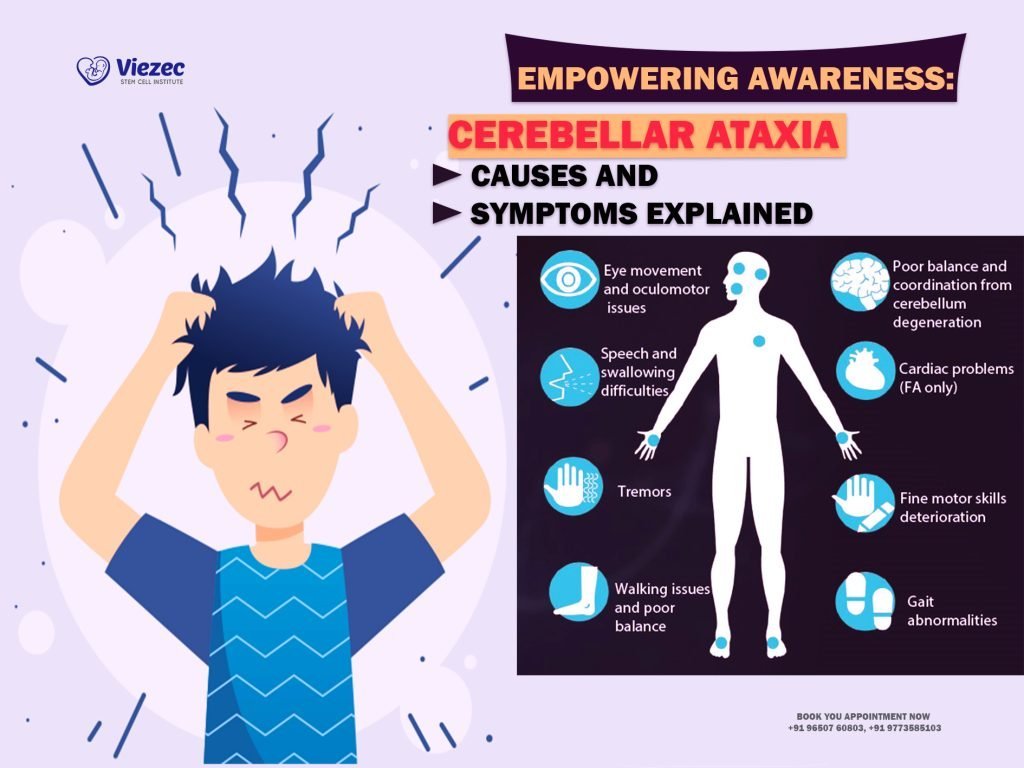
Symptoms of cerebellar ataxia typically develop gradually (in degenerative or genetic forms) or suddenly (in cases caused by stroke or infection). Common signs include:
- Unsteady, wide-based walking and frequent stumbling or falls
- Loss of fine motor control — difficulty writing, buttoning clothes, or handling small objects
- Slurred or slow speech (dysarthria)
- Involuntary eye movements (nystagmus) and difficulty tracking objects visually
- Tremor, particularly during purposeful movement
- Difficulty swallowing in more advanced cases
- Fatigue and, in some patients, cognitive or emotional changes
Symptoms can range from mild balance issues that are barely noticeable to significant disability affecting walking, speech, and daily independence. Severity and progression depend heavily on the underlying cause.
How Is It Diagnosed?
There is no single test for “ataxia” — diagnosis is a process of identifying why the cerebellum isn’t functioning normally. A typical work-up includes:
- Neurological examination — assessing gait, coordination, reflexes, and eye movements
- MRI or CT imaging — to look for structural changes, stroke, or cerebellar atrophy
- Blood tests — checking for vitamin deficiencies, thyroid function, and metabolic causes
- Genetic testing — where a hereditary form is suspected, especially with a family history
- Additional testing as needed — nerve conduction studies, lumbar puncture, or MS-specific imaging protocols, depending on the suspected cause
Getting a confirmed underlying diagnosis — including subtype where relevant — is the step that shapes every decision that follows, including whether regenerative approaches are a reasonable option to discuss at all.
How Is Cerebellar Ataxia Treated?
There is currently no cure for most forms of cerebellar ataxia. Treatment focuses on managing symptoms, slowing progression where possible, and maintaining function and independence for as long as possible.
Standard, well-established approaches include:
- Physical and occupational therapy — the most consistently evidence-supported intervention for improving balance, coordination, and daily function (see our exercise guidance for managing ataxia symptoms for specifics)
- Speech therapy for dysarthria and swallowing difficulties
- Treating the underlying cause where possible — for example, vitamin repletion, addressing autoimmune activity, or managing vascular risk factors
- Assistive devices — canes, walkers, or adaptive equipment as the condition progresses
- Medication, which can help manage some associated symptoms, though no drug currently reverses cerebellar degeneration itself
Where regenerative medicine fits in
Mesenchymal stem cell therapy for ataxia — including spinocerebellar ataxia — is an active area of research. A small number of case reports, pilot studies, and systematic reviews have explored whether MSC-based approaches can support neuroprotection or modestly improve function, with mixed and still-limited results; a 2021 systematic review and meta-analysis, for instance, found some improvement on standard ataxia rating scales across included studies but noted the evidence did not reach statistical significance and called for larger, better-controlled trials.
This means regenerative therapy for ataxia should currently be understood as investigational — a potential supportive option some patients explore alongside, not instead of, standard neurological care — rather than an established or guaranteed treatment. At Viezec, we begin every case with the diagnostic work-up above, discuss regenerative options honestly against what the current evidence does and doesn’t show, and coordinate care alongside physiotherapy and standard treatment of the underlying cause. You can read more about our approach to stem cell treatment for ataxia, including how cases are evaluated and what a treatment estimate involves.
Patients weighing treatment cost as part of their decision can find a breakdown on our ataxia treatment cost page.
Living With Cerebellar Ataxia
Beyond formal treatment, many patients benefit from structured daily movement and balance work. We’ve put together specific, practical guidance in Exercises for Managing Ataxia Symptoms, covering safe balance training, coordination drills, and when to involve a physiotherapist directly.
For patients with a progressive or degenerative course specifically, see our dedicated page on cerebellar degenerative ataxia for what to expect and how care plans typically adapt over time.
Frequently Asked Questions
No. Friedreich’s ataxia is one specific inherited cause of cerebellar ataxia. “Cerebellar ataxia” is the broader symptom pattern; Friedreich’s is one genetic condition that produces it.
It depends entirely on the cause. Ataxia from a vitamin deficiency or certain infections can improve significantly once treated. Genetic and degenerative forms currently cannot be reversed, though symptoms can often be managed.
No. It remains investigational. Current research shows some signals of possible benefit in small studies, but results are mixed and not yet supported by large-scale clinical trials. Anyone considering it should discuss realistic expectations with a qualified neurologist first.
Any new, unexplained, or worsening coordination problem — especially with slurred speech, falls, or vision changes — warrants a neurological evaluation. Early diagnosis meaningfully changes management for several underlying causes.
Sources
- Appelt PA, et al. Effect of stem cell treatment on functional recovery of spinocerebellar ataxia: systematic review and meta-analysis. Cerebellum & Ataxias. 2021.
- Lee GB, et al. The Potential of Mesenchymal Stem Cells in Treating Spinocerebellar Ataxia: Advances and Future Directions. Biomedicines. 2024.
- General clinical overview informed by standard neurology references on cerebellar ataxia diagnosis and management.
This page is for informational and educational purposes only and is not a substitute for professional medical advice. Stem cell and regenerative therapies referenced are investigational in India and are not positioned as a cure. Individual outcomes vary. Consult a qualified neurologist to discuss diagnosis and treatment options specific to your case. See our full safety and guarantees FAQ and research hub for more.