


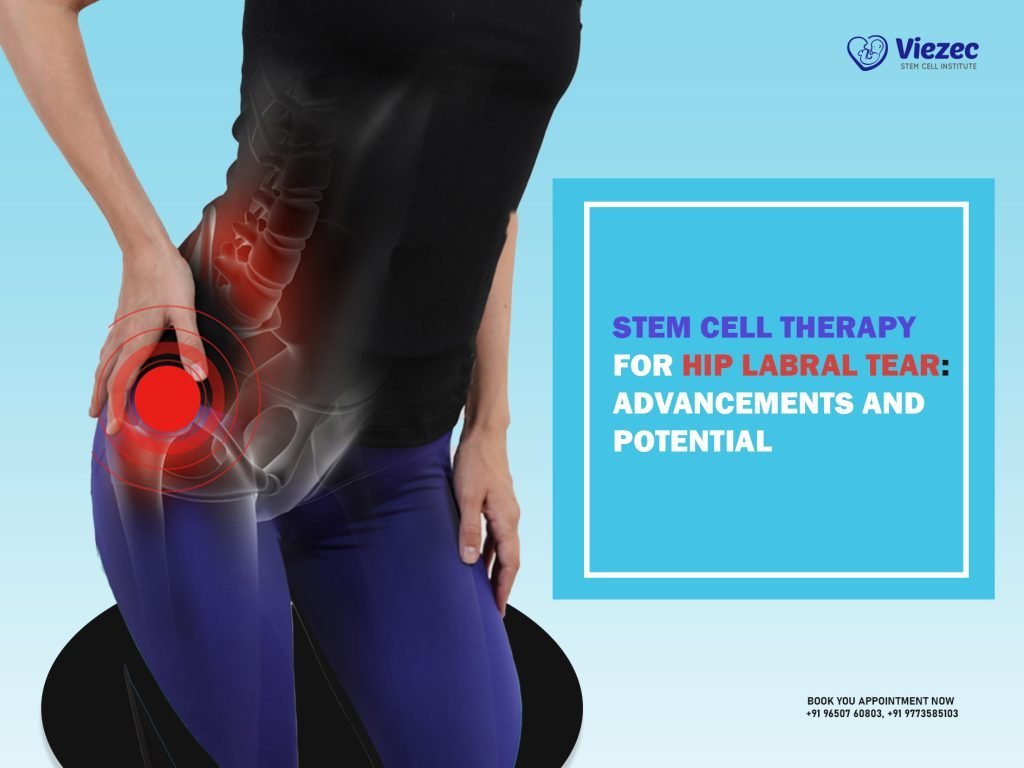
A torn hip labrum can turn ordinary movements — sitting, pivoting, tying your shoes — into a source of pain. For patients who want to avoid or delay surgery, stem cell and regenerative injection therapy is increasingly discussed as an option. This guide explains what a hip labral tear is, how regenerative therapy for it actually works, what the evidence and regulatory position in India currently say, and how to evaluate whether it’s right for you.
Quick Answer
Stem cell (mesenchymal cell / regenerative) therapy for a hip labral tear is an investigational, non-surgical option that aims to reduce inflammation and support tissue healing around the torn labrum. It is not currently recognised as standard-of-care treatment in India or the US, so it’s typically considered by patients who want to try a non-surgical route first, under the care of a qualified orthopedic specialist, with realistic expectations about outcomes.
What Is a Hip Labral Tear?
The labrum is a ring of cartilage that lines the rim of the hip socket (acetabulum). It works like a gasket — deepening the socket, cushioning the joint, and helping keep the ball of the femur seated securely. When it tears, the joint can lose some of that stability and cushioning, which is what produces the catching, clicking, or deep groin pain many patients describe.
Common Causes and Risk Factors
- Structural issues — femoroacetabular impingement (FAI), hip dysplasia, or an abnormally shaped hip joint that puts uneven stress on the labrum
- Repetitive motion — sports involving pivoting, twisting, or extreme hip range of motion (football, hockey, golf, dance, martial arts)
- Acute trauma — a fall, dislocation, or direct impact to the hip
- Degenerative wear — age-related thinning of the labrum, often overlapping with early hip osteoarthritis
Symptoms to Watch For
- Deep groin or hip pain, especially with prolonged sitting, standing, or walking
- A clicking, locking, or catching sensation in the joint
- Stiffness or reduced range of motion
- A feeling of instability or the hip “giving way”
- Pain radiating into the buttock or outer thigh
How Is a Hip Labral Tear Diagnosed?
Diagnosis typically starts with a clinical exam — including impingement and instability tests — followed by imaging. Plain X-rays help rule out bony abnormalities like FAI, while an MRI arthrogram (an MRI done with contrast dye injected into the joint) is the most reliable way to visualise the tear itself and grade its severity.
Treatment Options for a Hip Labral Tear
Most specialists work through a stepped approach:
- Conservative care — activity modification, physiotherapy to strengthen the hip stabilisers, anti-inflammatory medication, and targeted rest
- Image-guided injections — corticosteroid injections for short-term relief, or regenerative options such as PRP (platelet-rich plasma) and mesenchymal stem cell injections
- Arthroscopic surgery — minimally invasive repair, debridement, or reconstruction of the labrum when conservative measures fail or the tear is severe
Regenerative injection therapy generally sits in step 2 — considered by patients who have tried basic conservative care without full relief, and who want to explore a non-surgical option before committing to arthroscopy.
How Stem Cell Therapy Works for a Hip Labral Tear
Regenerative treatment for the hip typically involves an image-guided injection (ultrasound or fluoroscopy-guided) of one or a combination of:
- Mesenchymal stem cells (MSCs) — most commonly sourced from the patient’s own bone marrow or adipose (fat) tissue
- Platelet-rich plasma (PRP) — concentrated platelets from the patient’s own blood, often used alongside MSCs
The rationale is that these cells and growth factors release signalling proteins that can help modulate local inflammation and support the joint’s own repair processes. This is not the same as regrowing a fully torn labrum from scratch — it is generally framed as a way to reduce pain and inflammation and potentially support the health of the surrounding joint tissue, rather than a guaranteed structural repair.
The Evidence and Regulatory Picture — Read This Before You Decide
Responsible information here matters more than optimistic marketing, so here are the facts as they currently stand:
- In the United States, the FDA has not approved any stem cell product for orthopedic conditions, including hip labral tears or hip osteoarthritis. Most MSC-based treatments are classified as investigational, and legitimate providers operate under the HCT/P framework (21 CFR Part 1271) rather than a full drug approval.
- In India, mesenchymal stem cell (MSC) therapy is explicitly not recognised as standard of care for orthopedic conditions under the ICMR–DBT National Guidelines for Stem Cell Research, reaffirmed by a Supreme Court ruling in January 2026. Clinical trial data on orthopedic use has been described by ICMR as “encouraging,” but not yet sufficient to make it a routine, guaranteed treatment.
- This means any clinic offering it should be doing so either as part of a registered, ethics-committee-approved clinical trial, or using minimally manipulated, same-day autologous cells (the patient’s own cells, processed and re-injected in one sitting) — a narrower category some regulators treat differently from lab-expanded stem cell products.
What this means for you as a patient: ask any clinic direct questions before proceeding — is this part of a registered trial or a minimally manipulated same-day procedure? Which regulatory framework does it fall under? Can they share outcome data, not just testimonials? A transparent clinic will answer these clearly instead of deflecting.
Who Might Consider This Option
Regenerative injection therapy for a hip labral tear is typically discussed with patients who:
- Have a confirmed labral tear on MRI with persistent pain despite physiotherapy and conservative care
- Want to explore non-surgical options before considering arthroscopy
- Are in reasonably good general health, with no active infection, uncontrolled autoimmune disease, or untreated coagulation disorder
- Understand and accept that outcomes vary and are not guaranteed, and are being treated by a qualified orthopedic specialist under proper informed consent
It is generally not positioned as a substitute for surgery in cases of severe structural damage, large unstable tears, or significant underlying bony deformity (like advanced FAI) — those cases are usually better served by surgical correction.
Regenerative Therapy vs. Arthroscopic Surgery
| Factor | Regenerative Injection Therapy | Arthroscopic Surgery |
|---|---|---|
| Invasiveness | Minimally invasive, outpatient injection | Surgical, requires anaesthesia |
| Downtime | Days to a couple of weeks | Several weeks to months of rehab |
| Regulatory status (India/US) | Investigational / not standard of care | Established surgical standard |
| Best suited for | Mild-to-moderate tears, early-stage symptoms | Moderate-to-severe tears, structural deformity |
| Evidence base | Emerging, growing clinical trial data | Well-established long-term outcome data |
| Repeatability | Can potentially be repeated or combined with rehab | One-time procedure, revision surgery possible if needed |
What to Expect: Procedure and Recovery
- Consultation and imaging review — your MRI/MRI arthrogram is reviewed and candidacy assessed
- Cell/PRP preparation — a small sample of bone marrow, fat tissue, or blood is drawn and processed, typically the same day
- Image-guided injection — the prepared cells/PRP are injected precisely into the joint or surrounding structures under ultrasound or fluoroscopic guidance
- Initial recovery — mild soreness for a few days is common; most patients resume light activity within a week
- Structured rehabilitation — physiotherapy is typically prescribed over several weeks to support the joint as inflammation settles
- Follow-up review — reassessment (clinically, and sometimes with imaging) at intervals your specialist recommends to track progress
Cost Considerations
Cost varies significantly based on the type of cells used, the number of sessions, the facility’s protocols, and whether the procedure is part of a monitored trial. Rather than quoting a fixed figure that may not reflect your specific case, we’d recommend requesting a personalised assessment and cost breakdown once your MRI and case history have been reviewed — that’s the only way to get an accurate, honest number instead of a generic estimate.
How This Compares Across Hip Conditions
Hip labral tears are just one of several hip conditions where regenerative approaches are being explored. If you’re also researching how outcomes and evidence compare across conditions like osteoarthritis, our detailed success-rate breakdown for hip conditions walks through what current data shows across different diagnoses. For a broader look at regenerative therapy for the hip joint generally — including osteoarthritis, which is the most common reason patients explore this route — see our main guide on stem cell therapy for hip osteoarthritis.
Frequently Asked Questions
No. Per ICMR–DBT national guidelines, mesenchymal stem cell therapy is not currently recognised as standard-of-care for orthopedic conditions, including labral tears. It’s considered investigational, and reputable providers offer it either within a registered clinical trial or as a minimally manipulated, same-day autologous procedure.
There’s no reliable evidence that it fully regenerates a torn labrum structurally. It’s more commonly discussed as a way to manage inflammation and pain and support the joint’s healing environment, not as a guaranteed structural repair.
Patients who respond often notice initial changes in pain within 4–8 weeks, though timelines vary by individual, tear severity, and adherence to post-procedure rehabilitation.
The injection itself involves a needle stick and mild pressure; most clinics use local anaesthesia at the injection site. Mild soreness for a few days afterward is common.
PRP uses concentrated platelets from your own blood to deliver growth factors. Stem cell therapy uses mesenchymal cells (from bone marrow or fat) that may have broader regenerative signalling potential. The two are sometimes combined.
An orthopedic specialist experienced in hip preservation, ideally one who can clearly explain the regulatory basis of the procedure they’re offering and share realistic, evidence-based expectations rather than guaranteed outcomes.
Related Reading
- Stem Cell Therapy for Hip Osteoarthritis — our main guide to regenerative treatment for the hip joint
- Success Rates of Stem Cell Therapy for Hip Conditions — a data-focused comparison across hip diagnoses
- All Hip Conditions We Cover — browse our full hip-conditions resource hub
Medical disclaimer: This content is for general informational purposes and does not constitute medical advice. Stem cell and regenerative therapies for orthopedic conditions are investigational and not recognised as standard-of-care treatment in India or the United States. Outcomes vary by individual. Always consult a qualified, registered orthopedic specialist to evaluate your specific case before making any treatment decision.