


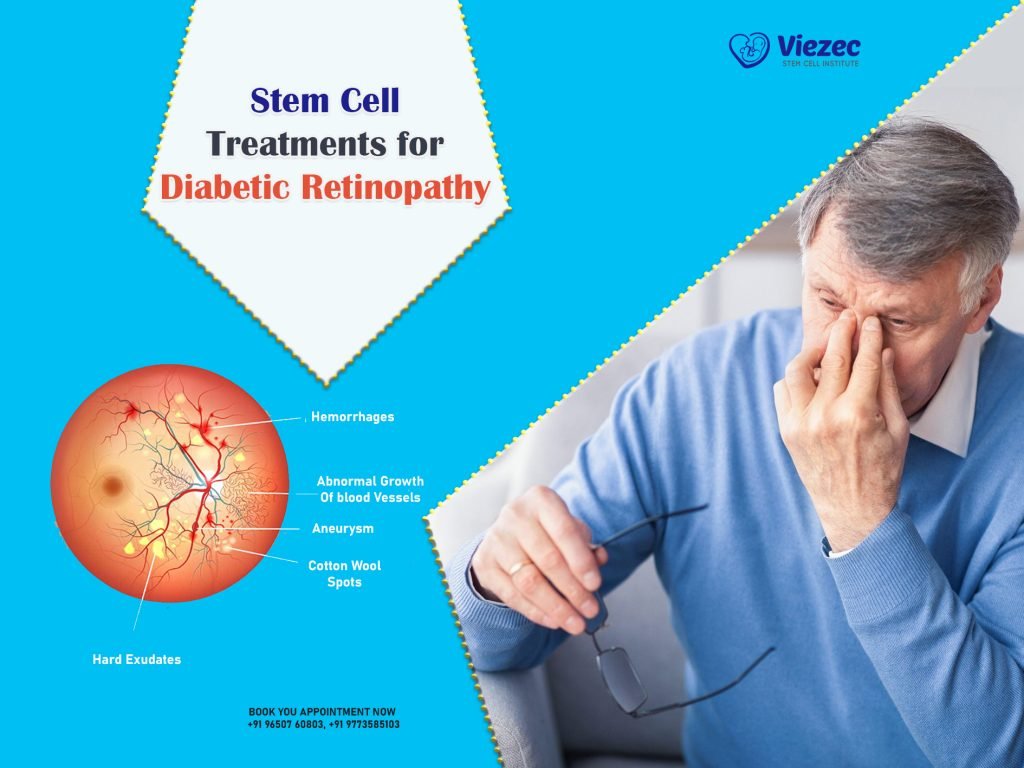
Diabetic retinopathy is one of the leading causes of preventable blindness in people with diabetes, affecting nearly one in three people who have lived with the condition for a long time. When high blood sugar damages the tiny blood vessels feeding the retina, it can lead to blurred vision, dark spots, and — if untreated — permanent vision loss. Conventional treatments such as laser photocoagulation and anti-VEGF injections can slow the disease, but they don’t repair the retinal tissue that’s already been damaged. Stem cell therapy is being explored as a regenerative option that works alongside conventional care to support retinal repair and preserve remaining vision.
At Viezec, we offer stem cell treatment for diabetic retinopathy in India, combining regenerative medicine with ongoing ophthalmology care to give patients a broader range of options for managing this condition.
Quick Answer
Stem cell treatment for diabetic retinopathy uses mesenchymal stem cells (MSCs) — most commonly sourced from bone marrow or umbilical cord tissue — to target damaged retinal blood vessels and support tissue repair. It is used as a complementary regenerative approach alongside standard treatments like anti-VEGF injections and laser therapy, not as a replacement for them in every case. Results vary by patient and disease stage, and it is best suited to patients who have plateaued on conventional treatment or want to explore additional regenerative support.
What Is Diabetic Retinopathy?
Diabetic retinopathy develops when consistently high blood sugar damages the small blood vessels in the retina — the light-sensitive layer at the back of the eye. Over time, these vessels can:
- Leak fluid or blood into the retina (causing swelling, known as diabetic macular edema)
- Become blocked, cutting off blood supply to parts of the retina
- Trigger the growth of new, abnormal blood vessels that are fragile and prone to bleeding (proliferative diabetic retinopathy)
Left untreated, this progression can lead to significant, often irreversible vision loss.
Why Conventional Treatment Alone Isn't Always Enough
| Treatment | What it does | Where it falls short |
|---|---|---|
| Laser photocoagulation | Seals leaking vessels, slows progression | Doesn’t restore vision or regenerate damaged tissue |
| Anti-VEGF injections | Reduces abnormal vessel growth and swelling | Requires repeated injections; some patients respond poorly |
| Vitrectomy (surgery) | Removes blood/scar tissue in advanced cases | Reserved for severe disease; doesn’t repair the retina itself |
This gap — treatments that manage the disease but don’t repair the tissue — is where regenerative approaches like stem cell therapy are being explored.
How Stem Cell Therapy Works for Diabetic Retinopathy
Stem cells used in retinal regenerative treatment are primarily mesenchymal stem cells (MSCs), valued for their ability to:
- Support angiogenesis — encouraging the formation of healthy new blood vessels to improve retinal blood supply
- Reduce inflammation — MSCs secrete anti-inflammatory and growth factors that create a more favorable environment for tissue repair
- Provide trophic (nourishing) support — helping protect surviving retinal cells from further degeneration
At Viezec, stem cells are typically administered via a minimally invasive procedure under the supervision of our regenerative medicine and ophthalmology team, following a full diagnostic work-up to confirm suitability.
Who Is a Candidate for This Treatment?
You may be a candidate for stem cell treatment for diabetic retinopathy in India if you:
- Have been diagnosed with non-proliferative or early proliferative diabetic retinopathy
- Have plateaued on, or are looking to complement, laser or anti-VEGF therapy
- Have reasonably controlled blood sugar levels (uncontrolled diabetes is typically stabilized first)
- Do not have active retinal bleeding or a condition that requires emergency surgical intervention
A retina specialist will review your OCT scans, fluorescein angiography, and diabetes history before confirming eligibility — every case is assessed individually.
What to Expect: The Treatment Process
- Consultation & diagnostics — retinal imaging, blood work, and diabetes control review
- Treatment planning — the team determines stem cell source (bone marrow-derived or umbilical cord-derived MSCs) and delivery method
- Procedure day — performed on an outpatient or short-stay basis
- Recovery & monitoring — follow-up eye exams to track retinal response over the following weeks and months
- Ongoing management — continued diabetes control and periodic ophthalmology check-ups remain essential after treatment
Safety, Realistic Expectations, and Evidence
Regenerative therapy for diabetic retinopathy is an evolving field. It’s important to go in with realistic expectations:
- Reported outcomes in published case series and early clinical studies include improved retinal function and stabilization of vision in some patients — but results vary by individual, and not every patient experiences the same degree of improvement.
- Stem cell therapy is generally positioned as a complement to, not a guaranteed replacement for, laser therapy and anti-VEGF injections.
- Long-term outcome data is still being gathered as research continues, and treatment should always be pursued through a qualified, experienced clinical team.
- This is not a treatment to self-administer or pursue without proper diagnostic screening — a full evaluation by a retina specialist is essential before any regenerative procedure.
Why Patients Choose Viezec in India
- Dedicated regenerative medicine team working alongside experienced ophthalmologists
- Individualized treatment planning based on OCT and angiography findings, not a one-size-fits-all protocol
- Significantly lower treatment cost compared to similar regenerative programs in the US, UK, or Gulf countries
- End-to-end support for international patients — consultation, treatment coordination, and follow-up care
Explore our related regenerative treatment programs: Stem Cell Treatment for Diabetic Neuropathy in India
Managing diabetes well is the single best way to protect your eyes long-term. See our diet guidance for diabetic patients.
Read a real patient’s experience: patient success stories
Frequently Asked Questions
When performed by a qualified regenerative medicine and ophthalmology team after proper diagnostic screening, stem cell treatment is considered a low-risk outpatient procedure. As with any regenerative therapy, long-term safety data is still being collected, and treatment should only be pursued through an experienced clinical provider.
Not in every case. Outcomes depend on the severity and stage of the disease, how much retinal damage has already occurred, and individual response to treatment. Some patients experience improved visual function and stabilization; complete restoration of lost vision is not guaranteed.
Laser therapy and anti-VEGF injections manage the disease by sealing leaking vessels or reducing abnormal vessel growth, but they don’t repair damaged retinal tissue. Stem cell therapy is a regenerative approach aimed at supporting tissue repair and is generally used alongside, not instead of, these conventional treatments.
Mesenchymal stem cells (MSCs), typically sourced from bone marrow or umbilical cord tissue, are the most commonly used cell type due to their anti-inflammatory and tissue-repair properties.
Cost depends on the stage of the disease, the number of sessions required, and individual treatment planning. India offers significantly lower costs than comparable programs in the US, UK, or Gulf countries — contact our team for a personalized cost estimate after your diagnostic review.
Patients with active retinal bleeding, uncontrolled blood sugar, or conditions requiring emergency surgical intervention are typically not immediate candidates until those issues are first stabilized. A retina specialist will confirm eligibility on a case-by-case basis.
Response times vary. Most treatment plans include follow-up retinal imaging at set intervals (e.g., 4-6 weeks, 3 months, 6 months) to objectively track changes in retinal function rather than relying on subjective vision reports alone.
Take the Next Step
If conventional treatment for your diabetic retinopathy has plateaued, or you want to explore regenerative options as part of your care plan, our team can review your case and let you know if you’re a suitable candidate.