


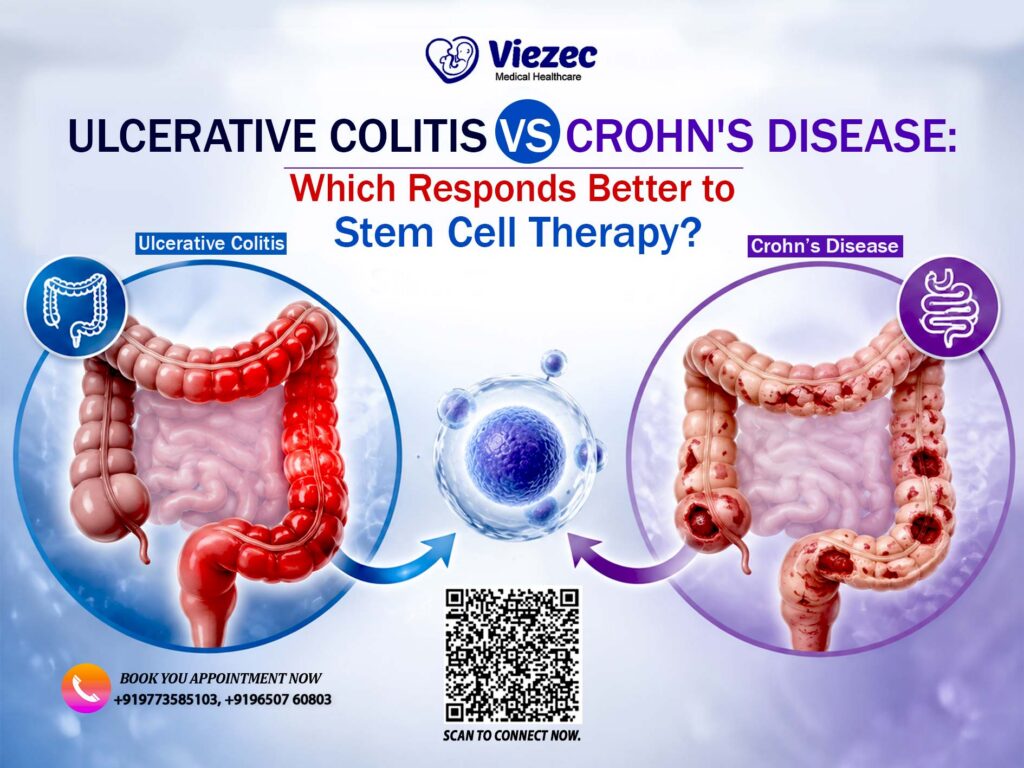
Inflammatory Bowel Disease (IBD) is an umbrella term for chronic, relapsing conditions that cause inflammation in the digestive tract. The two major forms — Ulcerative Colitis and Crohn’s Disease — share overlapping symptoms like abdominal pain, diarrhea, and fatigue, but they differ meaningfully in where and how they attack the gut. This difference matters more than most patients realize, especially when exploring newer options like stem cell therapy for IBD.
As conventional treatments (steroids, immunosuppressants, biologics) fail to control disease in a meaningful subset of patients, many are turning to regenerative approaches. But does stem cell therapy work the same way for both diseases? The honest answer is no — the clinical evidence so far tells two very different stories. This article breaks down what current research actually shows, so you can have an informed conversation with your gastroenterologist rather than relying on marketing claims.
What is Ulcerative Colitis?
Ulcerative Colitis (UC) is a chronic inflammatory condition that affects only the innermost lining (mucosa) of the colon and rectum. Unlike Crohn’s, UC inflammation is continuous — it typically starts at the rectum and spreads upward through the colon without skipping sections.
Common symptoms include:
- Bloody diarrhea
- Urgent, frequent bowel movements
- Abdominal cramping, especially before passing stool
- Fatigue and unintended weight loss
- Tenesmus (a persistent feeling of needing to empty the bowels)
Standard treatment options typically progress through 5-ASA compounds (like mesalamine), corticosteroids for flares, immunomodulators (azathioprine), and biologics (infliximab, vedolizumab). When these fail, colectomy (surgical removal of the colon) is sometimes the last resort. Because UC is confined to the mucosal layer, it’s generally considered more “surgically curable” than Crohn’s — but surgery comes with major lifestyle trade-offs, which is why many patients look into Ulcerative Colitis treatment alternatives before reaching that stage.
What is Crohn's Disease?
Crohn’s Disease can affect any part of the gastrointestinal tract, from the mouth to the anus, though it most commonly involves the end of the small intestine (ileum) and the beginning of the colon. Unlike UC, Crohn’s inflammation is often patchy (“skip lesions”) and transmural — meaning it penetrates through all layers of the bowel wall, not just the surface.
This deeper, full-thickness inflammation is why Crohn’s is associated with complications UC rarely produces:
- Fistulas (abnormal tunnels connecting the bowel to other organs or skin, especially perianal fistulas)
- Strictures (narrowing of the intestine)
- Abscesses
- Malabsorption and nutritional deficiencies
Standard treatments overlap with UC’s — 5-ASAs, steroids, immunomodulators, and biologics like adalimumab or ustekinumab — but Crohn’s often requires more aggressive, longer-term biologic therapy, and surgery does not “cure” it the way colectomy can address UC, since disease can recur elsewhere in the GI tract. Patients with treatment-resistant disease, particularly those with fistulizing Crohn’s, are increasingly researching Crohn’s Disease treatment options that go beyond standard biologics.
Confused Between Ulcerative Colitis & Crohn’s Disease?
Speak with our regenerative medicine experts to understand whether stem cell therapy may be a suitable option for your condition. Get personalized guidance based on your symptoms and medical history.
How Stem Cell Therapy Works for IBD
Most IBD-focused stem cell research centers on mesenchymal stem cells (MSCs) — multipotent cells typically sourced from bone marrow, adipose (fat) tissue, or umbilical cord tissue. MSCs are not primarily used to “regrow” bowel tissue; their main therapeutic value lies in immunomodulation.
MSCs work by:
- Suppressing overactive T-cells and pro-inflammatory cytokines (like TNF-alpha and IL-6) that drive chronic gut inflammation
- Secreting anti-inflammatory and growth factors that promote mucosal healing
- Modulating local immune cell behavior at the site of injection rather than acting systemically in some administration routes
Administration methods vary by target:
- Intravenous (IV) infusion — used for systemic, luminal inflammation (more common in UC and luminal Crohn’s research)
- Local/intralesional injection — used directly into fistula tracts (the primary method studied in Crohn’s perianal fistula trials)
A widely cited mechanistic review in Stem Cell Research & Therapy describes how MSCs modulate T-cell mediated immunity and help restore gut mucosal barrier integrity in colitis models and patients (Stem Cell Research & Therapy, 2024). This immunomodulatory mechanism is the foundation for both UC and Crohn’s research — but as you’ll see below, the clinical results diverge sharply depending on disease type and delivery method.
Stem Cell Therapy Response: Ulcerative Colitis
Evidence for MSC therapy in UC is genuinely promising but still mixed and early-stage.
A 2024 prospective clinical study using human umbilical cord-derived MSCs (UMSCs) in patients with moderate-to-severe, treatment-refractory UC found that at 2 months, 73.2% of patients undergoing UMSC transplantation achieved a clinical response, 41.5% exhibited clinical remission, and 43.9% experienced mucosal healing. However, these gains softened over time — by 6 months, remission and response rates had declined, though a meaningful proportion of patients maintained improvement (Stem Cell Research & Therapy, 2024).
Not all trials have shown clear benefit, though. A Russian randomized study combining bone marrow-derived MSCs with standard anti-inflammatory therapy for acute UC found that MSC therapy did not significantly change recurrence frequency, remission duration, or clinical/endoscopic activity scores during the first year of follow-up, though it noted a possible reduced exacerbation risk at the two-year mark (PubMed).
A broader systematic review of 32 clinical studies concluded that evidence for systemic MSC infusion in luminal IBD remains mixed, due to significant methodological heterogeneity across trials and unclear long-term safety data (MDPI, Systematic Review). In short: UC shows encouraging short-term signals, but consistent, large-scale, placebo-controlled confirmation is still lacking.
Stem Cell Therapy Response: Crohn's Disease
Crohn’s disease — specifically complex perianal fistulizing Crohn’s — has the most clinically advanced stem cell therapy story in all of IBD, and it’s a story worth understanding in full, including its recent setback.
Darvadstrocel (brand name Alofisel), an allogeneic adipose-derived MSC product injected directly into fistula tracts, became the first stem cell therapy approved in the European Union and Japan for complex Crohn’s perianal fistulas. That approval was based on the original ADMIRE-CD trial, which found that <cite index=”7-1″>a significantly greater proportion of patients receiving Alofisel, compared to controls, achieved combined remission at 24 weeks (51.5% vs 35.6%)</cite> (Takeda, ADMIRE-CD results).
However, a critical update matters here for anyone researching this therapy today: the larger follow-up trial, ADMIRE-CD II, did not replicate those results. In this expanded, phase 3 study of 568 patients, <cite index=”2-1″>combined remission at week 24 was achieved in 48.8% of the darvadstrocel group versus 46.3% of the placebo group — a difference that was not statistically significant</cite> (PubMed / Gastroenterology, Colombel et al.). Researchers noted the placebo response rate was unexpectedly high, and as a direct consequence, <cite index=”3-1″>Alofisel was withdrawn from the European market in late 2024</cite> (Gastroenterology journal editorial).
This doesn’t erase the underlying biological signal — local MSC injection for fistulas remains one of the best-studied stem cell applications in IBD, and a 2025 systematic review and meta-analysis still found <cite index=”6-1″>observational studies supporting the efficacy and safety of darvadstrocel for complex perianal fistulas</cite> (United European Gastroenterology Journal, 2025). But it does mean the regulatory and evidentiary picture for Crohn’s fistula therapy is currently in flux, not settled — an important distinction from how this therapy was often described a few years ago.
Comparative Analysis: Which Responds Better?
There is no single, definitive winner — the two diseases respond differently because the nature of their inflammation differs. Here’s a side-by-side breakdown:
| Factor | Ulcerative Colitis | Crohn’s Disease |
|---|---|---|
| Inflammation type | Continuous, mucosal-only | Patchy, transmural (full-thickness) |
| Typical stem cell delivery | IV infusion (systemic) | Local injection (fistula-targeted) |
| Strongest evidence base | Early-phase, single-arm and small RCTs | Large phase 3 RCTs (ADMIRE-CD, ADMIRE-CD II) |
| Best documented outcome | Short-term clinical response/remission in refractory UC | Fistula closure in complex perianal disease (mixed by trial) |
| Regulatory status | No approved MSC product for UC anywhere | Previously EU/Japan-approved (Alofisel); withdrawn from EU market in Dec 2024 after ADMIRE-CD II results |
| Consistency across trials | Inconsistent — some positive, some null results | Inconsistent — positive in ADMIRE-CD, null in ADMIRE-CD II |
The honest takeaway: Localized delivery for a well-defined, anatomically discrete target (a fistula tract) produces more measurable endpoints than treating diffuse mucosal inflammation across an entire colon. This is why Crohn’s fistula therapy reached regulatory approval first. But “reached approval first” is not the same as “proven superior” — the failed confirmatory trial is a reminder that a single positive study, even a large one, doesn’t guarantee durable real-world efficacy. Meanwhile, UC’s evidence, while less mature, has shown a fairly consistent immunomodulatory signal across multiple small studies using umbilical cord-derived MSCs specifically.
Rather than asking “which disease responds better” as a yes/no question, the more accurate framing is: stem cell therapy for IBD is genuinely promising but disease-course-dependent, delivery-method-dependent, and still evolving — not a settled, one-size-fits-all answer for either condition.
Factors That Influence Response
Several variables affect how any individual patient — UC or Crohn’s — is likely to respond to stem cell therapy:
- Disease severity and duration: Patients with long-standing, heavily scarred, or fibrotic tissue tend to respond less predictably than those with earlier-stage inflammation.
- Prior treatment history: Heavy prior exposure to biologics and immunosuppressants (common in refractory patients enrolled in these trials) can complicate response, partly because these patients represent a harder-to-treat population to begin with.
- Overall health and nutritional status: Malnutrition and low body mass, common in advanced Crohn’s, can affect healing capacity.
- Cell source — autologous vs. allogeneic: Autologous MSCs (from the patient’s own tissue) avoid immune rejection risk but may carry the patient’s own inflammatory “memory.” Allogeneic (donor-derived) MSCs, like those used in darvadstrocel, offer more standardized dosing but depend on donor cell quality and batch consistency.
- Fistula anatomy (for Crohn’s): Simpler fistula tracts tend to close more reliably than complex, multi-branching tracts.
Safety, Limitations, and Current Research Status
It’s important to be direct about where things stand: stem cell therapy for IBD remains largely investigational. Outside of darvadstrocel’s now-narrowed regulatory status in specific regions, no MSC-based therapy is broadly approved as a standard-of-care treatment for either Ulcerative Colitis or Crohn’s Disease in most countries, including the United States.
Reported safety profiles across trials have generally been favorable — adverse event rates in the darvadstrocel trials were similar between treatment and placebo groups — but long-term data (beyond 1–2 years) remains limited for most protocols, and outcomes vary widely by clinic, cell source, and administration technique.
If you’re considering this route, we strongly recommend:
- Discussing your specific case with a board-certified gastroenterologist before pursuing regenerative treatment
- Reviewing registered, ongoing studies on ClinicalTrials.gov to understand current trial-stage evidence
- Asking any clinic offering stem cell therapy for exact cell source, dosing protocol, and published outcome data — not just anecdotal testimonials
Explore a Personalized Stem Cell Treatment Plan
Every inflammatory bowel disease is different. Contact our specialists to discuss your diagnosis, treatment goals, and whether regenerative therapy could support your recovery journey.
Why Choose Viezec for Stem Cell Therapy?
Choosing the right provider is an important part of your treatment journey. At Viezec, our experienced team offers personalized regenerative medicine programs for patients from India and around the world. Recognized by many patients as one of the leading stem cell centers in India, we focus on patient safety, individualized treatment planning, and comprehensive care. If you are searching for an experienced doctor for stem cell therapy, a trusted stem cell hospital, or compassionate stem cell care backed by clinical expertise, explore how Viezec’s regenerative medicine team can help you make an informed treatment decision.
Conclusion
Ulcerative Colitis and Crohn’s Disease may share the IBD label, but they don’t share an inflammation pattern — and that difference shapes how each responds to stem cell therapy. Crohn’s fistulizing disease has the longer, more rigorous trial history, though its most prominent product recently hit a major setback in confirmatory testing. UC’s evidence is younger and more limited in scale, but shows a fairly consistent early signal, particularly with umbilical cord-derived MSCs.
Neither disease currently has a stem cell therapy that qualifies as a guaranteed cure, and any clinic suggesting otherwise should be treated with caution. What both diseases do have is a growing, legitimate body of research worth discussing with a specialist.
If you’re exploring whether stem cell therapy could be appropriate for your specific diagnosis, disease history, and treatment-resistance profile, our medical team at Viezec can help you understand where the current evidence stands for your case and connect you with the information you need to make a fully informed decision.
Frequently Asked Questions
Darvadstrocel (Alofisel) was approved in the EU and Japan specifically for complex perianal fistulas in Crohn’s disease, based on the original ADMIRE-CD trial. However, it was withdrawn from the European market in December 2024 after a larger confirmatory trial (ADMIRE-CD II) failed to show a statistically significant benefit over placebo. It is not approved for luminal (non-fistulizing) Crohn’s disease or in the United States.
No. There is currently no MSC-based therapy formally approved for Ulcerative Colitis anywhere. Existing data comes from smaller clinical trials showing short-term response and remission benefits, primarily using umbilical cord-derived MSCs, but results are not yet consistent enough across studies for regulatory approval.
Neither has a definitively “better” response overall. Localized Crohn’s fistula treatment has produced more measurable, trial-tested endpoints because it targets a discrete anatomical site, while UC treatment (typically via IV infusion) targets diffuse mucosal inflammation, which is harder to measure and treat uniformly. Evidence quality and consistency, not raw effectiveness, is the real differentiator right now.
Most research uses mesenchymal stem cells (MSCs) sourced from bone marrow, adipose tissue, or umbilical cord tissue. These are chosen for their immunomodulatory properties rather than their ability to regenerate tissue directly.
Reported trials show generally favorable safety profiles, with adverse event rates similar to placebo groups in major studies. However, long-term safety data beyond 1–2 years is still limited, and outcomes can vary significantly based on cell source, dosing, and clinic protocol.
Administration depends on the target: intravenous (IV) infusion is typically used for systemic, luminal inflammation in UC and luminal Crohn’s, while local or intralesional injection directly into fistula tracts is the primary method studied for Crohn’s perianal fistulas.
Disclaimer: This article is for informational and educational purposes only and does not constitute medical advice. Stem cell therapy for Inflammatory Bowel Disease is an evolving area of research, and treatment availability, regulatory approval, and clinical evidence vary by country and continue to change. Please consult a qualified gastroenterologist or physician before making any treatment decisions.