


Quick Answer
Stem cell therapy for torn ligaments uses the patient’s own (or donor-derived) mesenchymal stem cells, injected into the injured ligament to support the body’s natural repair process. Compared with surgery, it is minimally invasive, generally has a shorter downtime, and is explored as an option for partial ligament tears such as ACL, MCL, and ankle ligament injuries. In India, this therapy is offered at accredited regenerative medicine centers at a fraction of the cost of comparable care in the US, UK, or Gulf countries — though it remains an investigational treatment, not a guaranteed cure, and eligibility depends on the tear’s severity and the patient’s overall health.
Understanding Torn Ligaments
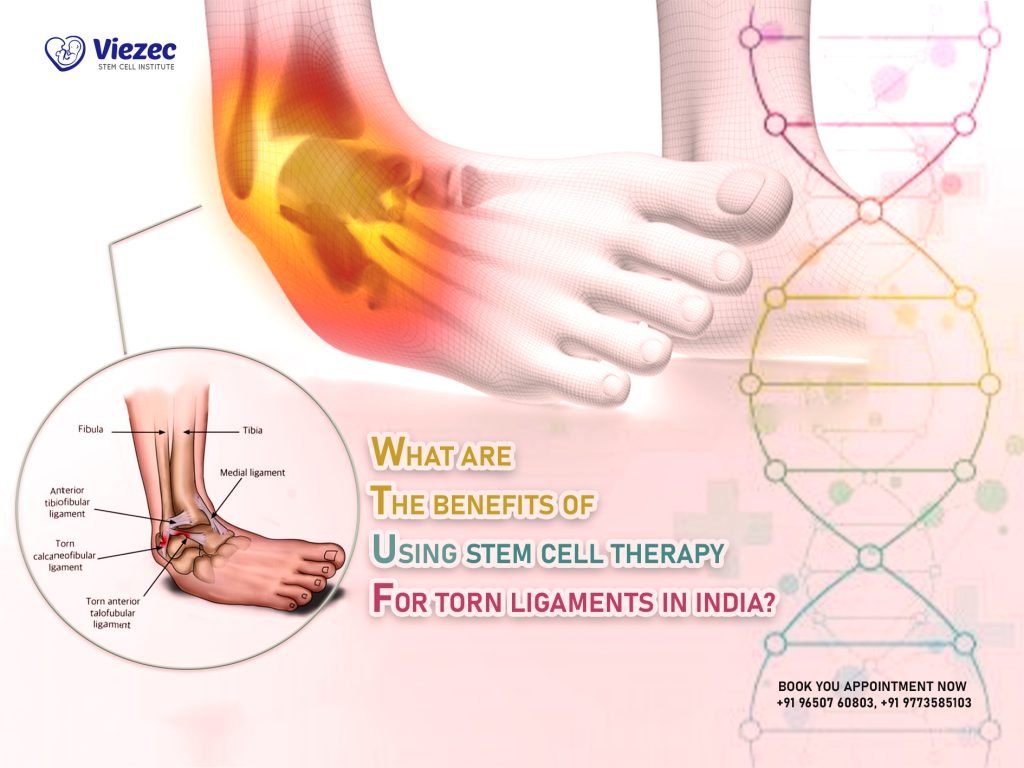
stabilize your joints. A tear happens when a ligament is stretched beyond its normal range — commonly during sports, a fall, a road accident, or a sudden twisting movement. The knee (ACL, MCL, PCL), ankle, and shoulder ligaments are the most frequently injured.
Ligament tears are graded by severity:
- Grade I (mild): Overstretched fibers, minimal instability
- Grade II (moderate): Partial tear, some joint looseness
- Grade III (severe): Complete tear, significant instability — usually the hardest category for regenerative approaches alone and often still needs surgical opinion
This grading matters because it’s the single biggest factor in whether a regenerative, non-surgical approach is even worth discussing with a specialist.
Traditional Treatment vs. Stem Cell Therapy
| Factor | Traditional Treatment (Physio / Surgery) | Stem Cell Therapy |
|---|---|---|
| Invasiveness | Surgery involves incisions, anesthesia, grafts | Image-guided injection, no incision |
| Recovery time | Often 6–12 months post-surgery | Typically shorter downtime, varies by case |
| Tissue outcome | Scar tissue / graft replacement | Aims at regenerating native-like tissue |
| Risk profile | Infection, blood clots, anesthesia risk | Minor injection-site pain, less surgical risk |
| Best suited for | Complete (Grade III) tears | Partial to moderate tears, as an adjunct or alternative |
| Repeatability | Surgery is generally a one-time fix | Can sometimes be combined with rehab/PRP |
Note: this is a general comparison for education — the right path depends entirely on imaging (MRI) findings and a specialist’s evaluation. Neither approach is universally “better”; they suit different tear severities.
How Stem Cell Therapy Works for Ligament Repair
The therapy typically uses mesenchymal stem cells (MSCs), sourced from the patient’s own bone marrow or adipose (fat) tissue, or in some protocols from donor-derived (allogeneic) sources. Once processed under lab conditions, they’re injected directly into the torn ligament under ultrasound or fluoroscopic guidance. Inside the joint, MSCs are studied for their ability to:
- Signal repair — release growth factors and cytokines that recruit the body’s own healing cells to the injury site
- Reduce inflammation — modulate the local immune response, which is linked to pain and swelling reduction
- Support matrix remodeling — assist in organizing new collagen fibers rather than disorganized scar tissue
This is the same underlying science covered in more depth in our article on how stem cell therapy works and in our dedicated piece on the mechanisms of stem cell therapy for tendon and ligament injuries, which goes deeper into the research and clinical trial data behind this approach.
Key Benefits of Stem Cell Therapy for Torn Ligaments
1. Minimally Invasive
No large incisions, no general anesthesia in most protocols — the procedure is typically an outpatient injection.
2. Shorter Downtime Than Surgery
Because there’s no surgical wound to heal, many patients return to light daily activity sooner than after ligament reconstruction surgery — though full recovery still depends on rehab compliance.
3. Lower Risk of Surgical Complications
No graft harvesting, no risk of hardware-related issues, and a lower risk profile for infection or blood clots compared with open or arthroscopic surgery.
4. Supports Tissue Regeneration, Not Just Symptom Relief
Rather than only managing pain, the goal is to support the body’s own regenerative capacity at the site of the tear.
5. Personalized, Autologous Option Available
When the patient’s own cells are used, the risk of immune rejection is minimized.
6. Can Be Combined With Other Therapies
Stem cell injections are sometimes used alongside platelet-rich plasma (PRP) treatment, physiotherapy, or rehabilitation therapy for a layered recovery plan.
Which Ligament Injuries Can Be Considered
- ACL (Anterior Cruciate Ligament) — the most researched application, generally for partial tears
- MCL (Medial Collateral Ligament) — often responds well to conservative and regenerative approaches
- PCL (Posterior Cruciate Ligament)
- Ankle ligament sprains/tears (e.g., ATFL)
- Shoulder ligament and capsule injuries — see our related page on stem cell therapy for sports injuries for the broader category
If your injury is a rotator cuff tear rather than a ligament tear, see our related guide: can rotator cuff injuries heal without surgery?
Why Patients Choose India for This Treatment
- Cost advantage: treatment costs in India are typically a fraction of equivalent care in the US, UK, or GCC countries for comparable protocols
- Accredited facilities: GMP-compliant labs and experienced regenerative medicine teams
- Specialist access: orthopedic and regenerative medicine specialists with focused experience in joint and connective-tissue cases
- Structured patient journey: most international patients complete evaluation, treatment, and initial follow-up within 1–3 weeks — see the international patient guide for visa, travel, and stay logistics
Treatment Process, Step by Step
- Medical history & MRI review — confirms tear grade and candidacy
- Cell sourcing — bone marrow aspiration or adipose tissue extraction (or donor-derived cells, depending on protocol)
- Lab processing — cells are isolated and prepared under controlled conditions
- Image-guided injection — cells are delivered precisely into the ligament under ultrasound/fluoroscopy
- Structured rehabilitation — a physiotherapy plan is typically prescribed to support the regenerative process (see our full procedure of stem cell therapy for the general clinical workflow)
Cost of Stem Cell Therapy for Torn Ligaments in India
Cost depends on the ligament involved, tear grade, number of sessions, and whether the protocol includes adjunct therapies like PRP or physiotherapy. As a directional guide, India’s pricing is significantly below comparable protocols in Western countries — but exact figures require a case-specific quote after your MRI and medical history are reviewed. Request a personalized estimate through the appointment page.
Safety, Risks & Who Is Eligible
When performed at accredited facilities with certified, GMP-processed cells, stem cell therapy for ligament injuries generally has an acceptable safety profile. Reported side effects are typically mild and temporary:
- Injection-site soreness or swelling
- Temporary low-grade fever
- Rare allergic-type reactions
Not every torn ligament is a candidate. Complete (Grade III) ruptures, certain instability patterns, or specific comorbidities may make surgery the more appropriate first-line option. A qualified specialist should review your MRI and history before recommending any protocol — this content is educational, not a treatment guarantee. For the full risk profile, see stem cell adverse reaction and treatment safety.
Recovery Timeline & What to Expect
Recovery varies by tear grade, cell source, and how closely the rehabilitation plan is followed. Some patients report early improvements within weeks, while structural changes and functional gains typically develop over a few months. Outcomes are individual — no responsible clinic should promise a fixed timeline or guaranteed result for an investigational therapy. See our stem cell success rate page for how outcomes are generally reported across conditions.
Frequently Asked Questions
Most patients describe the injection as mildly uncomfortable rather than painful, similar to other joint injections. Local anesthesia is often used at the injection site.
Not always. It’s generally considered for partial tears or as part of a broader treatment plan; complete ruptures often still require a surgical opinion.
Yes — in fact, most protocols pair the injection with a structured rehabilitation plan, since the mechanical loading from physiotherapy supports tissue remodeling.
This varies by individual and tear severity — some notice changes within weeks, others over a few months. There’s no universal timeline.
There’s no strict age cutoff, but candidacy depends more on the tear grade, joint health, and overall medical condition than age alone.
Through MRI imaging, a physical exam, and a review of your medical history by the treating specialist.
It is offered as an investigational/regenerative-medicine option through specialized clinics rather than as a universally standardized surgical alternative. Always discuss regulatory status and evidence with your treating physician.