Intracerebral hemorrhage (ICH) is bleeding inside the brain, and it’s one of the most serious forms of stroke. Researchers are actively studying whether stem cell therapy can support the brain’s recovery process after a patient has been medically stabilized. This guide explains what ICH is, what standard emergency treatment looks like, where stem cell research currently stands, and what to honestly expect if you’re exploring it for a patient in the recovery phase.
Quick Answer
Stem cell therapy for intracerebral hemorrhage is an emerging, investigational approach studied for the post-acute recovery phase — not a replacement for emergency stroke treatment. Early-phase human trials (small groups, safety-focused) suggest it may be feasible and well-tolerated, but there is not yet large-scale evidence proving it improves recovery outcomes. It is typically considered only after a patient is medically stable, alongside standard rehabilitation, and under specialist supervision.
If This Is Happening Right Now: Seek Emergency Care Immediately
Intracerebral hemorrhage is a medical emergency. If you or someone near you suddenly shows any of the following signs, call your local emergency number immediately — do not wait, and do not search for treatment information first:
- Balance — sudden loss of balance or coordination
- Eyes — sudden vision loss or double vision
- Face — one side of the face drooping
- Arm — sudden weakness or numbness in one arm
- Speech — slurred or garbled speech
- Time — time to call emergency services immediately
Other warning signs include a sudden, severe headache, vomiting, confusion, seizures, or loss of consciousness. Every minute matters — outcomes depend heavily on how fast a patient reaches emergency care.
What Is Intracerebral Hemorrhage?
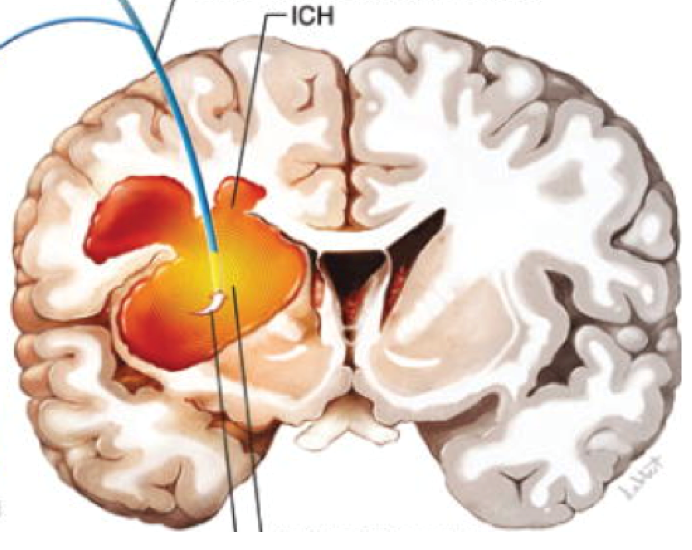
ICH happens when a blood vessel inside the brain tears or ruptures, leaking blood directly into brain tissue. The pooled blood (a hematoma) raises pressure inside the skull and cuts off oxygen to surrounding cells, which is why brain damage can occur within minutes. ICH is less common than ischemic stroke (caused by a clot) but tends to be more severe, accounting for roughly 13–15% of all strokes.
Common Causes and Risk Factors
- Chronic high blood pressure — the leading cause of spontaneous ICH
- Cerebral amyloid angiopathy — weakening of small brain blood vessels, more common in older adults
- Blood thinning medications or clotting disorders
- Aneurysms or arteriovenous malformations (AVMs)
- Head trauma
- Substance use, including heavy alcohol use or stimulant drugs
How Is ICH Diagnosed and Treated in the Emergency Phase?
Diagnosis is made with urgent brain imaging — typically a CT scan, sometimes followed by CT angiography or MRI to identify the bleed’s cause and extent. Standard emergency treatment focuses on:
- Stabilizing vital signs — airway, breathing, circulation
- Rapidly controlling blood pressure to limit further bleeding
- Reversing any blood-thinning medication the patient may be on
- Managing intracranial pressure, including surgical evacuation of the hematoma in select cases
- Close neurocritical care monitoring for the first days after the bleed
This acute, hospital-based care is the established standard of treatment and is not something stem cell therapy is intended to replace.
Discover if Stem Cell Therapy Can Help You!
Book a Free Consultation with Our Experts at Viezec !
Where Stem Cell Therapy Fits In
Once a patient is medically stabilized, the brain enters a longer recovery phase — this is where ICH stem cell research is focused. The hypothesis being studied is that mesenchymal stem cells (MSCs), typically delivered intravenously, may help modulate inflammation around the injury site and support the brain’s natural repair processes, potentially aiding functional recovery alongside rehabilitation. This is investigational research, not an emergency intervention, and it does not reverse the original bleed or the tissue damage it already caused.
What Does Current Research Actually Show?
It’s important to be direct about the evidence stage here rather than overstate it:
- A Mayo Clinic phase I dose-escalation trial gave intravenous allogeneic bone-marrow-derived MSCs to a small group of acute ICH patients (9 enrolled from 140 screened) and found the infusions to be feasible and safe at the doses tested — but the study was designed to test safety, not to prove the therapy improves recovery.
- Broader reviews of the ICH stem cell research field describe results in animal models as promising, while noting that human clinical trials remain limited in size, and that larger, randomized, placebo-controlled studies are still needed before stem cell therapy could be considered an established treatment.
- No stem cell product is currently approved by regulators anywhere for treating ICH. It remains a research-stage therapy being explored at specialized centers and within clinical trials.
What this means practically: if a clinic presents this as a guaranteed way to reverse brain damage from a hemorrhage, that claim goes beyond what current evidence supports. A credible provider will tell you plainly that this is investigational, explain the specific protocol and cell source being used, and set realistic expectations rather than promises.
Regulatory Status in India
In India, stem cell interventions outside of established hematopoietic stem cell transplantation are governed by the ICMR–DBT National Guidelines for Stem Cell Research, which state that any such use in patients is investigational and should only be carried out within a registered, ethics-committee-approved clinical trial, at a facility with proper institutional stem cell research committee (IC-SCR) registration. This applies to neurological applications, including stroke and ICH, just as it does to orthopedic conditions. Before proceeding with any facility, it’s reasonable to ask directly whether the treatment is part of a registered trial, what regulatory framework it operates under, and what safety and outcome data they can share.
Who Might Be a Candidate for Investigational Stem Cell Therapy
This is typically discussed only for patients who:
- Have been medically stabilized following the acute bleed, with imaging confirming no ongoing active bleeding
- Are in the sub-acute or chronic recovery phase and working through a structured rehabilitation program
- Have no active infection, uncontrolled systemic illness, or other contraindication identified by their treating neurologist
- Understand this is a research-stage option, not a proven cure, and are making an informed decision with their medical team
What to Expect: Process and Recovery Support
- Medical stabilization first — this always comes before any discussion of regenerative therapy
- Neurological and imaging assessment — to confirm the patient is an appropriate candidate for investigational therapy
- Cell sourcing and preparation — typically bone-marrow or donor-derived mesenchymal cells, prepared under lab protocols
- Administration — usually intravenous infusion, done in a monitored clinical setting
- Structured rehabilitation — physiotherapy, occupational therapy, and speech therapy continue in parallel, as these remain the evidence-backed core of stroke recovery
- Ongoing monitoring — follow-up assessments to track tolerability and any changes in function over time
Risks and Safety Considerations
Early-phase trials have reported the infusions as generally well-tolerated at studied doses, but as with any investigational cell therapy, patients and families should ask about infection risk, immune reactions (particularly with donor-derived cells), and the qualifications of the facility administering treatment. Ask whether the center follows Good Manufacturing Practice (GMP) standards for cell processing and has documented safety monitoring protocols.
Cost Considerations
Because this is a specialized, investigational procedure, cost varies by cell source, number of infusions, and the facility’s protocols and monitoring requirements. Rather than publishing a generic figure that may not apply to a specific case, we’d recommend requesting a personalized assessment once the patient’s medical records and stage of recovery have been reviewed by a specialist.
Start Your Regenerative Journey Today!
Contact Viezec for Personalized Stem Cell Therapy Plan
Frequently Asked Questions
It’s studied for the recovery phase, after the bleed has been medically managed. It is not an emergency treatment and does not replace the standard urgent care (blood pressure control, monitoring, and surgery when needed) that ICH requires immediately.
Not yet at a large-scale level. Early human trials have focused on safety and feasibility, with promising but preliminary results. Larger randomized controlled trials are still needed before it can be considered an established, evidence-backed treatment.
This depends entirely on the individual’s stability and recovery trajectory, and is a decision made by the treating neurology team — there’s no fixed universal timeline.
No stem cell product is currently approved anywhere specifically for ICH. In India, it falls under ICMR’s investigational framework and should only be offered within a registered clinical trial or under a clearly explained, regulator-compliant protocol.
Ask what clinical trial (if any) the treatment is part of, what cell source and dose are used, what safety data they can share, and what realistic outcomes past patients have had — not testimonials, but documented data.
Medical disclaimer: This content is for general informational purposes and does not constitute medical advice. Intracerebral hemorrhage is a life-threatening medical emergency — anyone showing signs of stroke should seek emergency care immediately. Stem cell therapy for ICH recovery is investigational, is not approved as a standard treatment in India or elsewhere, and outcomes vary by individual. Always consult a qualified neurologist or neurosurgeon to evaluate any specific case before making a treatment decision.
List of References
Current Status and Progress in Stem Cell Therapy for ICH – review summarizing developmental history, transplantation strategies, enhancement methods, and barriers to clinical translation.
https://pubmed.ncbi.nlm.nih.gov/38001353/
Stem Cell Therapy: A Promising Method for ICH – review of therapeutic mechanisms (neurogenesis, anti-inflammation) and the need for more clinical evidence.
https://pubmed.ncbi.nlm.nih.gov/29871521/
Mesenchymal Stem Cell Therapy Clinical Trial (Mayo Clinic) – current interventional Phase 1 study investigating safety/feasibility of MSC therapy in recent spontaneous ICH.
https://www.mayo.edu/research/clinical-trials/cls-20379665
Preclinical Meta-Analysis of Stem Cell Transplantation in ICH – shows behavioral and structural improvements, highlights administration routes and timing effects, cautioning study quality.
https://pubmed.ncbi.nlm.nih.gov/26409481/
Adipose-Derived Stem Cells Improve Neurological Outcomes in ICH Model – rodent evidence that intravenous stem cell delivery can ameliorate cognitive and motor deficits (preclinical success).
https://www.sciencedirect.com/science/article/pii/S0006899318306681