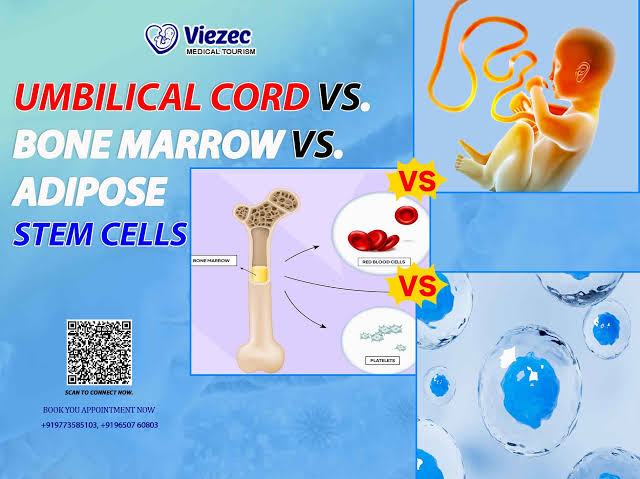
If you’ve started researching regenerative treatment options, you’ve probably noticed that “stem cell therapy” isn’t a single, standardized product. The source of the cells matters just as much as the therapy itself. Umbilical cord, bone marrow, and adipose (fat) tissue are the three most commonly used sources of mesenchymal stem cells (MSCs), and each has a distinct biological profile.
Understanding the differences in umbilical cord vs bone marrow vs adipose stem cells can help you have a more informed conversation with your treatment team. This guide walks through what each source is, what the science says about their strengths, and which conditions each is typically considered best suited for — without overstating what any of them can do.
Key Takeaways
- Source matters as much as the therapy itself — umbilical cord, bone marrow, and adipose MSCs differ meaningfully in proliferation rate, immune profile, and tissue-forming potential, so “stem cell therapy” isn’t one-size-fits-all.
- Umbilical cord (Wharton’s jelly) MSCs stand out for immune modulation — their high proliferation rate and low immunogenicity make them a frequent focus for autoimmune and neurological research.
- Bone marrow remains the gold standard for orthopedic applications — strongest osteogenic/chondrogenic potential and the deepest clinical track record, though harvesting is more invasive and yield/quality decline with age.
- Adipose-derived MSCs offer abundant, easy-to-harvest cells — with strong angiogenic and anti-inflammatory signaling that supports their use in wound healing, soft tissue repair, and aesthetic/anti-aging applications.
- The “best” source depends on the condition and should be personalized — a qualified specialist needs to weigh diagnosis, history, and goals against the current evidence rather than picking a source in isolation.
What Are Stem Cells & Why Source Matters
Mesenchymal stem cells (MSCs) are adult stem cells capable of self-renewal and limited differentiation into bone, cartilage, and fat-forming cells. Their therapeutic value, however, comes less from becoming new tissue and more from their secretory activity — the growth factors, cytokines, and signaling molecules they release, which can help modulate inflammation and support the body’s own repair processes.
Not all MSCs behave identically. Their age, the tissue they’re harvested from, and the conditions under which they were collected all shape how they proliferate, how strongly they modulate the immune system, and which tissue types they support best. That’s why matching the source to the condition is a meaningful clinical consideration, not just a matter of availability.
FREE EXPERT GUIDANCE
Not Sure Which Stem Cell Source Is Right for You?
Our regenerative medicine specialists evaluate your condition and recommend whether Umbilical Cord, Bone Marrow, or Adipose Stem Cells may be the most appropriate option for your treatment goals.
Umbilical Cord-Derived MSCs
Umbilical cord MSCs are typically isolated from Wharton’s jelly, the gelatinous connective tissue surrounding the umbilical vessels. Because the cord is a birth byproduct that’s otherwise discarded, collection is non-invasive and raises no ethical concerns for the donor or the newborn.
Wharton’s jelly-derived MSCs (WJ-MSCs) are prized for a few consistent properties observed across the literature:
- High proliferation rate — WJ-MSCs generally expand faster in culture than adult bone marrow-derived cells, making them easier to produce in large, consistent batches.
- Strong immunomodulatory activity — Comparative studies have found that WJ-MSCs show a distinct immunomodulatory and pro-regenerative gene expression profile relative to bone marrow-derived cells (Hass et al., Cell Communication and Signaling, 2011.
- Low immunogenicity — Their relatively immature, “younger” cellular profile tends to provoke less immune recognition, which supports their use in allogeneic (donor-derived) applications.
Because of this immune-modulating strength, umbilical cord stem cell therapy is frequently discussed in the context of autoimmune conditions, where dialing down an overactive immune response is central to the therapeutic goal. A comparative analysis of immunosuppressive characteristics across bone marrow, Wharton’s jelly, and adipose-derived MSCs found that all three sources suppressed T-cell proliferation, though the degree and mechanism differed by source (Karaöz et al., 2017, Turkish Journal of Haematology).
Beyond autoimmune applications, umbilical cord MSCs are also being studied for neurological conditions and general immune modulation in the context of wellness and anti-aging protocols, largely due to their youthful secretory profile and low donor-site morbidity (there’s no invasive harvest from the patient at all, since cells come from a donor cord).
If you’re comparing sources for an autoimmune disease stem cell treatment, umbilical cord-derived cells are among the most frequently discussed options in current research, though ongoing trials are still working to establish long-term efficacy across specific conditions.
Bone Marrow-Derived MSCs
Bone marrow was the original source from which MSCs were first isolated and characterized, and it remains the historical “gold standard” against which newer sources are measured. Cells are typically harvested from the iliac crest (hip bone) under local or general anesthesia.
Key properties of bone marrow-derived MSCs (BM-MSCs) include:
- Strong osteogenic and chondrogenic potential — Across multiple comparative studies, BM-MSCs consistently show superior differentiation into bone- and cartilage-forming cells compared with adipose or umbilical cord sources.
- Decades of clinical familiarity — More published clinical data exists for BM-MSCs in orthopedic applications than for any other source, partly because it’s the oldest and most studied.
- Collection is more invasive — Bone marrow aspiration involves a needle into the marrow cavity, which carries more discomfort and procedural risk than a cord donation or a liposuction-based fat harvest.
- Age-related decline — Both the yield and proliferative quality of a patient’s own bone marrow MSCs tend to decrease with age, which is a meaningful consideration for autologous (self-donor) treatments in older patients.
These properties make bone marrow stem cell treatment a frequent choice for orthopedic and musculoskeletal applications. A multicenter randomized controlled trial found that intra-articular injection of autologous bone marrow MSCs improved pain and function scores in knee osteoarthritis patients compared with hyaluronic acid alone (Lamo-Espinosa et al., 2016, Journal of Translational Medicine). Systematic reviews of cartilage-repair trials have likewise reported consistent, though heterogeneous, improvements in pain and joint function following BM-MSC injection (systematic review, PMC, 2019.
Bone marrow MSCs are also studied in the context of certain blood disorders, reflecting the tissue’s natural role supporting hematopoiesis (blood cell production) in the body. For patients specifically researching orthopedic stem cell therapy or knee/joint stem cell treatment, bone marrow remains one of the most extensively documented sources available.
Adipose-Derived MSCs
Adipose (fat) tissue is now recognized as one of the richest and most accessible sources of MSCs in the adult body. Cells are typically harvested via mini-liposuction, a relatively low-morbidity outpatient procedure.
Notable properties of adipose-derived MSCs (AD-MSCs) include:
- Abundant yield — A foundational comparative study found that adipose tissue yields substantially more colony-forming stem cell units per gram than bone marrow yields per milliliter, meaning far fewer cells need to be harvested from the patient to reach a usable dose (Kern et al., 2006, Stem Cells).
- Faster, easier harvesting — Liposuction under local anesthesia is generally considered less invasive and less painful than bone marrow aspiration.
- Strong angiogenic and anti-inflammatory signaling — AD-MSCs are noted for robust paracrine (signaling) activity that supports new blood vessel formation and dampens local inflammation, which is valuable in wound healing and soft-tissue repair.
- Comparable, sometimes superior, proliferation — Several donor-matched comparison studies have found that adipose-derived cells proliferate faster and retain their multipotency longer in culture than bone marrow cells from the same patient.
Because of these properties, adipose-derived stem cell therapy is frequently explored for soft tissue repair, chronic wound healing, and aesthetic or anti-aging applications, where its angiogenic and anti-inflammatory signaling is thought to support tissue quality and skin regeneration. Adipose MSCs are also used in some orthopedic contexts, particularly softer joint and tendon applications, though bone marrow generally retains the edge for bone-formation-heavy indications.
Comparison Table: Umbilical Cord vs Bone Marrow vs Adipose Stem Cells
| Feature | Umbilical Cord (Wharton’s Jelly) | Bone Marrow | Adipose Tissue |
|---|---|---|---|
| Collection method | Donated postpartum cord tissue | Needle aspiration from iliac crest | Mini-liposuction |
| Invasiveness | None for patient (donor-derived) | Moderate–high | Low–moderate |
| Cell yield | High, consistent (donor cord) | Lower per volume; declines with age | High per gram of tissue |
| Proliferation rate | High | Moderate | High |
| Immunomodulatory strength | Strong | Moderate–strong | Moderate, strong anti-inflammatory signaling |
| Best-suited conditions | Autoimmune disease, neurological support, general immune modulation | Orthopedic/joint repair, cartilage and bone conditions, some blood disorders | Soft tissue repair, wound healing, aesthetic/anti-aging, select orthopedic uses |
Choosing a stem cell source is only half the picture — many patients also ask how exosomes compare with stem cell treatment before deciding which regenerative option suits their condition.
Which Source Is Best for Which Condition?
There’s no single “best” stem cell source — the right choice depends on the condition being treated and the biological mechanism that condition responds to.
- Autoimmune conditions (e.g., lupus, rheumatoid arthritis, MS-related symptoms): Umbilical cord-derived MSCs are frequently favored for their strong immunomodulatory profile and low immunogenicity.
- Orthopedic and joint conditions (e.g., osteoarthritis, cartilage defects): Bone marrow-derived MSCs remain the most studied option, with adipose-derived cells increasingly used as a less invasive alternative for softer joint applications.
- Wound healing and soft tissue repair: Adipose-derived MSCs are often preferred due to their angiogenic and anti-inflammatory signaling strength.
- Anti-aging and general wellness protocols: Both umbilical cord and adipose sources are commonly discussed, depending on whether immune modulation or tissue-quality support is the primary goal.
- Neurological conditions: Umbilical cord MSCs are an active area of research given their proliferative capacity and immunomodulatory strength, though this remains a developing field.
This mapping reflects general patterns in the current research on mesenchymal stem cells for autoimmune disease, orthopedic repair, and soft tissue regeneration — not a guarantee of outcome for any individual patient. Every case still needs individualized evaluation.
Take the Next Step Toward Regenerative Healing
Choosing the right stem cell source can make a significant difference. Speak with Viezec’s medical team for a personalized treatment recommendation based on your medical condition.
Choosing the Right Source: Why Personalization Matters
Reading about stem cell sources in the abstract is useful, but the right choice for you depends on your specific diagnosis, medical history, age, and treatment goals — factors a website article can’t fully account for. A qualified specialist can weigh the evidence for each source against your individual case and explain realistic expectations, including what current research does and doesn’t support.
If you’re weighing your options, it’s also worth reviewing stem cell therapy cost considerations across different sources, since collection method and cell processing can affect pricing. For a deeper primer on the basics, see our related post, What Is Mesenchymal Stem Cell Therapy?
Our team at Viezec can help you understand which source may be most appropriate for your condition based on current clinical evidence. We encourage you to book a consultation with our specialists for a personalized recommendation before making any treatment decisions.
The source of regenerative cells influences which growth-factor profile is used — a factor that also shapes how exosome therapy is applied by organ type, since delivery and dosing vary by target tissue.
References
- Karaöz, E., Demircan, P. Ç., Erman, G., Güngörürler, E., & Sarıboyacı, A. E. (2017). Comparative Analyses of Immunosuppressive Characteristics of Bone-Marrow, Wharton’s Jelly, and Adipose Tissue-Derived Human Mesenchymal Stem Cells. Turkish Journal of Haematology. https://www.ncbi.nlm.nih.gov/pmc/articles/PMC5544040/
- Kern, S., Eichler, H., Stoeve, J., Klüter, H., & Bieback, K. (2006). Comparative Analysis of Mesenchymal Stem Cells from Bone Marrow, Umbilical Cord Blood, or Adipose Tissue. Stem Cells, 24(5), 1294–1301. https://doi.org/10.1634/stemcells.2005-0342
- Lamo-Espinosa, J. M., Mora, G., Blanco, J. F., et al. (2016). Intra-Articular Injection of Two Different Doses of Autologous Bone Marrow Mesenchymal Stem Cells Versus Hyaluronic Acid in the Treatment of Knee Osteoarthritis: Multicenter Randomized Controlled Clinical Trial (phase I/II). Journal of Translational Medicine, 14(1), 246. https://doi.org/10.1186/s12967-016-0998-2
- Hass, R., et al. Human Wharton’s Jelly-Derived Stem Cells Display a Distinct Immunomodulatory and Proregenerative Transcriptional Signature Compared to Bone Marrow-Derived Stem Cells. https://pubmed.ncbi.nlm.nih.gov/29267140/
- Zuk, P. A., Zhu, M., Mizuno, H., Huang, J., Futrell, J. W., Katz, A. J., Benhaim, P., Lorenz, H. P., & Hedrick, M. H. (2001). Multilineage Cells from Human Adipose Tissue: Implications for Cell-Based Therapies. Tissue Engineering, 7(2), 211–228.
- Comparative Proteomic Analysis of the Mesenchymal Stem Cells Secretome from Adipose, Bone Marrow, Placenta and Wharton’s Jelly. (2021). International Journal of Molecular Sciences, 22(2), 845. https://doi.org/10.3390/ijms22020845
Frequently Asked Questions
There’s no single “best” source overall. Each has different strengths: umbilical cord (Wharton’s jelly) cells show strong immune-modulating activity, bone marrow cells have the strongest track record for bone and cartilage repair, and adipose cells are abundant, easy to harvest, and support soft tissue and wound healing. The right choice depends on the condition being treated.
Umbilical cord MSCs are collected from donated postpartum tissue that would otherwise be discarded, so there’s no invasive procedure on the patient. Their relatively immature cellular profile also tends to provoke a lower immune response, which is one reason they’re studied for allogeneic (donor-derived) use. As with any regenerative treatment, safety depends on proper screening, processing, and administration by a qualified provider.
Bone marrow was the original tissue MSCs were isolated from, so it has the longest clinical track record — particularly for bone and cartilage-related applications. Comparative studies consistently show bone marrow MSCs have strong osteogenic (bone-forming) and chondrogenic (cartilage-forming) potential, which is why they’re frequently used for orthopedic and joint conditions.
Generally, yes. Adipose cells are collected via mini-liposuction, which is typically considered less invasive than a bone marrow needle aspiration from the hip bone. Adipose tissue also yields substantially more stem cells per gram than bone marrow yields per milliliter, meaning less tissue often needs to be collected.
Research suggests umbilical cord-derived MSCs may be particularly well-suited to autoimmune conditions because of their strong immunomodulatory signaling and low immunogenicity. That said, this is still an active area of research, and outcomes vary by individual diagnosis and case.
Source selection should be personalized based on your diagnosis, medical history, and treatment goals — not chosen from a general comparison alone. A qualified specialist can review your case and recommend the source and protocol best supported by current evidence for your situation.