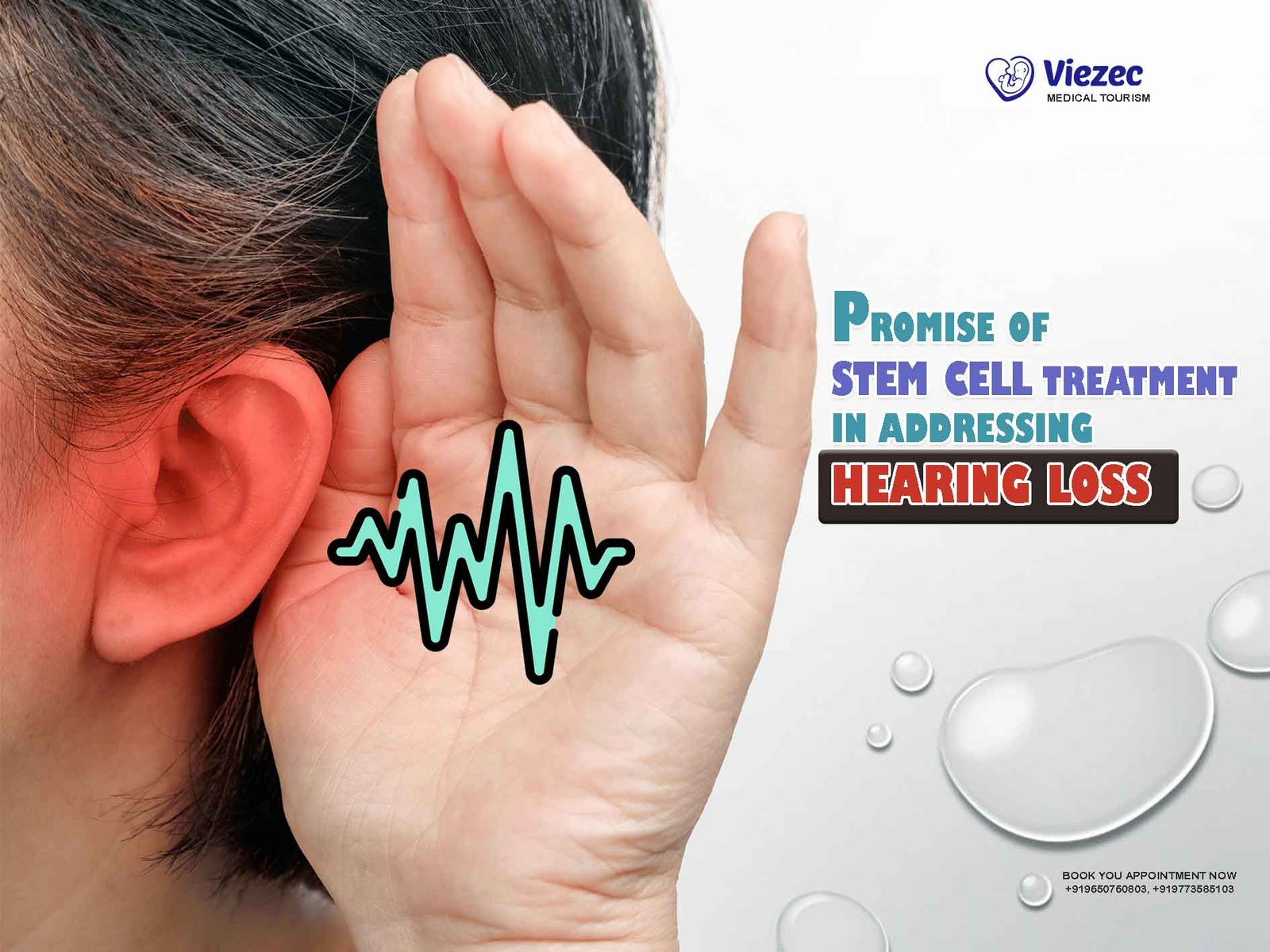
Hearing loss affects millions of people worldwide and often develops gradually, making it easy to overlook until it begins to interfere with daily life. Conversations become difficult. Social interactions feel exhausting. Simple sounds such as doorbells, birds, or music lose clarity. For many, hearing loss is not just a physical condition. It impacts emotional health, confidence, relationships, and overall quality of life.
Traditional treatments such as hearing aids and cochlear implants help manage symptoms, but they do not restore damaged hearing structures. This limitation has led researchers and patients to explore regenerative approaches. Among them, stem cell treatment has emerged as one of the most promising areas of research for addressing hearing loss at its root cause.
This page explores the science, current research, potential benefits, limitations, and future outlook of stem cell therapy for hearing loss. It is written to help patients, caregivers, and health-conscious readers understand this evolving field clearly and realistically.
Understanding Hearing Loss and Its Root Causes
Hearing loss occurs when sound signals cannot travel effectively from the ear to the brain. It can affect one or both ears and may range from mild to profound. Understanding the underlying cause is essential when evaluating advanced treatment options such as stem cell therapy.
Common Types of Hearing Loss
Sensorineural hearing loss
This is the most common type and occurs due to damage to the inner ear or auditory nerve. It is often caused by aging, noise exposure, infections, or certain medications.
Conductive hearing loss
This results from problems in the outer or middle ear that block sound transmission. Causes include ear infections, fluid buildup, or structural abnormalities.
Mixed hearing loss
This is a combination of sensorineural and conductive hearing loss.
Stem cell research primarily focuses on sensorineural hearing loss because it involves damage to hair cells and neurons that currently do not regenerate naturally in humans.
Why Conventional Treatments Have Limitations
Hearing aids amplify sound. Cochlear implants bypass damaged parts of the ear to stimulate the auditory nerve. These technologies are valuable, but they do not repair damaged cells.
Key limitations include:
-
No regeneration of lost hair cells
-
Dependence on external devices
-
Variable outcomes based on severity
-
Limited benefit in advanced degeneration
-
Ongoing maintenance and adaptation challenges
Because hearing loss often progresses, many patients look for solutions that aim beyond symptom management. This is where regenerative medicine becomes relevant.
Discover if Stem Cell Therapy Can Help You!
Book a Free Consultation with Our Experts at Viezec !
Introduction to Stem Cell Therapy
Stem cells are unique cells capable of self-renewal and differentiation into specialized cell types. In regenerative medicine, they are studied for their ability to repair or replace damaged tissues.
Types of Stem Cells Studied for Hearing Loss
Mesenchymal stem cells (MSCs)
Derived from bone marrow, adipose tissue, or umbilical cord tissue. MSCs are widely researched due to their safety profile and regenerative signaling effects.
Induced pluripotent stem cells (iPSCs)
Adult cells reprogrammed to behave like embryonic stem cells. These can potentially differentiate into inner ear hair cells.
Neural progenitor cells
These are studied for their potential to regenerate auditory neurons.
Each type has distinct advantages and challenges, and research continues to refine their application in hearing restoration.
How Stem Cell Therapy May Help in Hearing Loss
Stem cell therapy does not function like a hearing aid. Its goal is biological repair and regeneration.
Potential Mechanisms of Action
Regeneration of hair cells
Inner ear hair cells convert sound vibrations into electrical signals. Once damaged, they do not naturally regenerate. Stem cells may help replace or stimulate regeneration of these cells.
Repair of auditory nerve pathways
Stem cells may support nerve repair by releasing growth factors that enhance neural survival and connectivity.
Reduction of inflammation
Chronic inflammation can worsen inner ear damage. Stem cells have immunomodulatory properties that may protect existing structures.
Improved cellular environment
Stem cells release bioactive molecules that support tissue repair, even if they do not fully transform into hair cells.
These combined effects are what make stem cell therapy a compelling area of research for hearing loss.
Current Research and Clinical Progress
Stem cell therapy for hearing loss is still in the research and early clinical stages, but progress is steady.
Key Research Highlights
-
Animal studies have shown partial restoration of hearing thresholds after stem cell transplantation
-
Laboratory models demonstrate successful differentiation of stem cells into hair cell-like structures
-
Early-phase human studies focus on safety, feasibility, and biological response
-
Combination approaches using gene therapy and stem cells are under investigation
While results vary, the overall trend supports continued exploration of stem cells as a regenerative strategy rather than a temporary aid.
Start Your Regenerative Journey Today!
Contact Viezec for Personalized Stem Cell Therapy Plan
Who May Be a Candidate for Stem Cell Therapy
Not every case of hearing loss responds the same way to regenerative approaches. Careful patient evaluation is essential.
Potentially Suitable Candidates
-
Individuals with sensorineural hearing loss
-
Patients with noise-induced or age-related hearing damage
-
Cases where hearing aids provide limited benefit
-
Patients in early to moderate stages of degeneration
Cases Where Results May Be Limited
-
Complete destruction of auditory nerve pathways
-
Congenital hearing loss with structural absence
-
Advanced inner ear scarring
-
Severe systemic medical conditions
A personalized medical assessment is critical before considering any form of regenerative therapy.
Procedure Overview and Safety Considerations
Stem cell treatment protocols vary depending on the research model and clinical approach. Safety remains the primary focus.
General Process
-
Medical evaluation and diagnostic testing
-
Identification of suitable stem cell source
-
Controlled administration route, often intravenous or localized
-
Monitoring for immune response or adverse effects
-
Follow-up assessments of hearing function
Safety Profile
Mesenchymal stem cells, in particular, have been studied extensively and show a favorable safety record when processed and administered correctly. However, outcomes depend on clinical expertise, patient condition, and treatment protocol.
Expected Outcomes and Realistic Expectations
It is important to approach stem cell therapy with informed expectations.
What Stem Cell Therapy May Offer
-
Stabilization of hearing loss progression
-
Partial improvement in sound clarity
-
Enhanced speech perception
-
Improved response to conventional hearing devices
What It Does Not Guarantee
-
Complete hearing restoration
-
Immediate results
-
Uniform outcomes across all patients
Hearing improvement, when it occurs, is often gradual and varies by individual.
Role of Stem Cell Therapy in Combination Care
Stem cell treatment is not necessarily a replacement for existing therapies. It may work best as part of an integrated care plan.
Combination strategies may include:
-
Hearing aids for amplification support
-
Auditory rehabilitation therapy
-
Nutritional and lifestyle optimization
-
Ongoing monitoring and hearing assessments
This holistic approach aligns with current best practices in regenerative medicine.
Ethical and Regulatory Landscape
Stem cell therapy operates within a strict ethical and regulatory framework, particularly in India.
Key considerations include:
-
Use of ethically sourced stem cells
-
Compliance with national medical guidelines
-
Transparency in treatment claims
-
Patient safety and informed consent
Reputable organizations focus on responsible research and patient education rather than exaggerated promises.
Why India Is Emerging as a Hub for Regenerative Medicine
India has become a significant center for stem cell research and clinical innovation due to:
-
Advanced medical infrastructure
-
Skilled clinicians and researchers
-
Cost-effective healthcare delivery
-
Growing regulatory clarity
-
Increasing patient awareness
Viezec, based in India, contribute to this ecosystem by focusing on education, research support, and patient guidance in advanced therapies.
Is Your Condition Eligible for Stem Cell Therapy?
Speak directly with our specialist.
How Viezec Supports Patients Exploring Stem Cell Options
Navigating stem cell treatment options can be complex. Patients often need clear, unbiased information to make informed decisions.
Viezec plays a role in bridging the information gap by:
-
Providing evidence-based insights into regenerative therapies
-
Supporting patient education on evolving treatments
-
Connecting individuals with credible research-driven approaches
-
Emphasizing safety, transparency, and ethical standards
By focusing on awareness rather than hype, Viezec helps patients understand both the potential and the limitations of stem cell treatment for hearing loss.
Frequently Asked Questions
Most stem cell applications for hearing loss are still under clinical research or early-phase use. Regulatory approval varies by country and treatment protocol.
If improvement occurs, it is usually gradual over weeks or months rather than immediate.
Stem cell administration is generally minimally invasive, depending on the delivery method used.
Current research does not support a guaranteed cure for complete or congenital deafness. Outcomes depend on remaining auditory structures.
When conducted under proper medical supervision using ethically sourced cells, safety profiles are generally favorable. Individual risks must be assessed by a qualified professional.
Final Thoughts
Hearing loss has long been considered irreversible, particularly when caused by damage to inner ear hair cells or auditory nerves. Stem cell research challenges this assumption by offering a regenerative perspective focused on repair rather than compensation.
Although stem cell therapy for hearing loss is not yet a universal solution, it represents a meaningful step toward biological restoration. For patients seeking advanced options beyond conventional devices, understanding this therapy is an important part of informed decision-making.
With continued research, ethical practice, and patient-centered care, the promise of stem cell treatment in addressing hearing loss continues to grow. Viezec contribute to this journey by promoting clarity, education, and responsible exploration of regenerative medicine.