Hearing loss and deafness affect millions of people worldwide and can significantly impact communication, mental health, and overall quality of life. While hearing aids and cochlear implants have helped many patients manage hearing loss, they do not restore natural hearing. This has led researchers and patients alike to explore innovative approaches that aim to repair the underlying cause of deafness rather than simply amplify sound.
One of the most promising areas of research is stem cell treatment for deafness. Regenerative therapy focuses on repairing or replacing damaged cells inside the inner ear and auditory nerve, potentially offering a biological way to restore hearing function. Although this field is still developing, growing scientific evidence suggests that stem cell therapy for hearing loss could become a major breakthrough in regenerative medicine.
This guide explains how stem cell therapy for deafness works, who may benefit, what the science says, potential risks, and what patients in India and globally should know before considering this treatment.
Understanding Deafness and Hearing Loss
To understand how regenerative therapy may help, it is important to first understand how hearing works and what causes deafness.
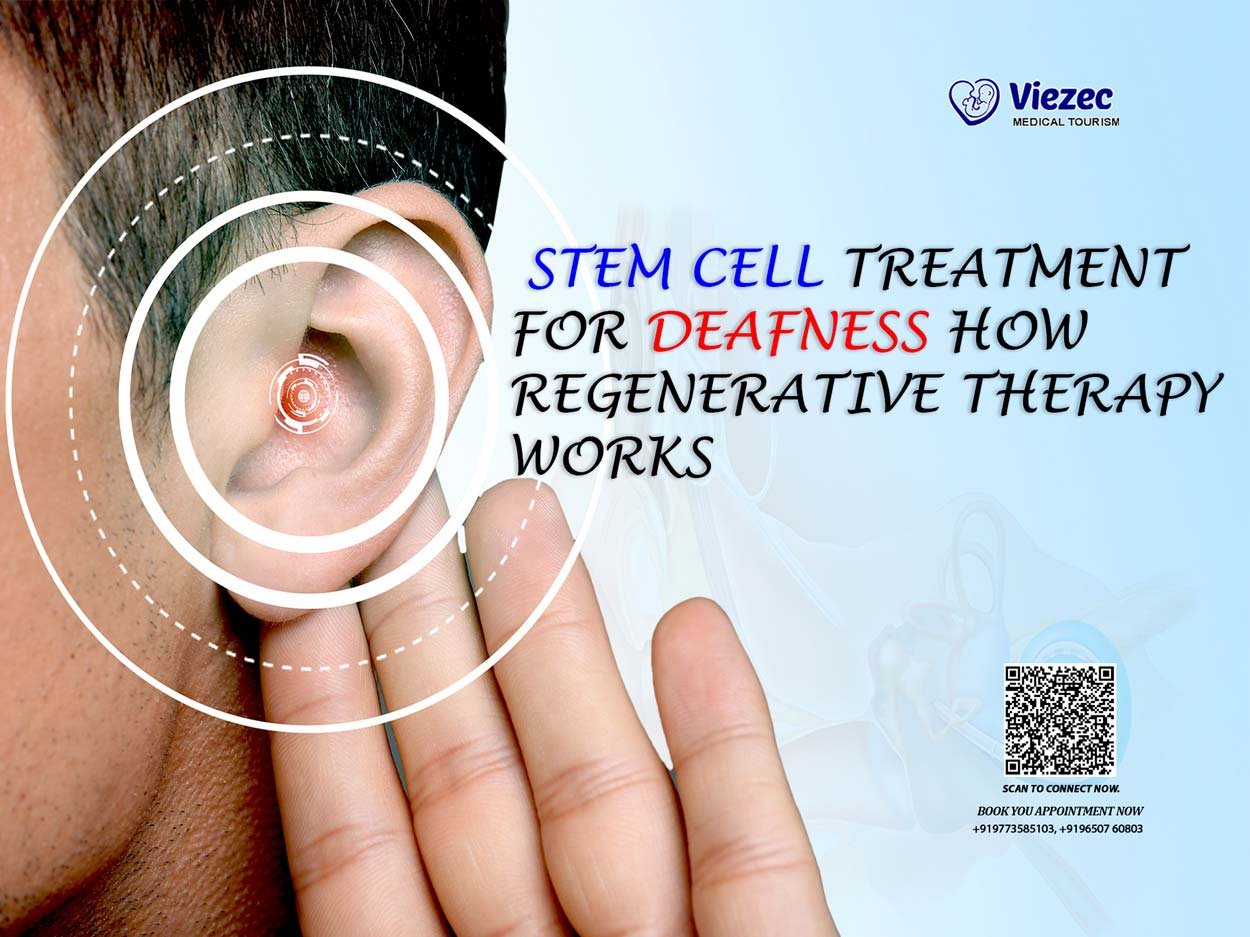
Sound waves enter the ear canal and travel to the middle and inner ear. Inside the inner ear is the cochlea, which contains delicate hair cells that convert sound vibrations into electrical signals. These signals are then sent to the brain through the auditory nerve. Damage to any of these structures can lead to hearing loss.
Common Types of Hearing Loss
Sensorineural hearing loss
This is the most common type and occurs when the inner ear hair cells or auditory nerve are damaged. Causes include aging, noise exposure, infections, genetic conditions, and certain medications.
Conductive hearing loss
This happens when sound cannot properly travel through the outer or middle ear due to blockages, fluid, or structural issues.
Mixed hearing loss
A combination of sensorineural and conductive hearing loss.
Most cases of permanent deafness are related to sensorineural hearing loss, which is the main focus of stem cell research.
Why Current Treatments Are Limited
Traditional treatments such as hearing aids and cochlear implants are highly valuable, but they do not repair damaged inner ear cells.
-
Hearing aids amplify sound but do not restore damaged hair cells.
-
Cochlear implants bypass damaged hair cells and stimulate the auditory nerve directly, but hearing is not fully natural.
-
Medications and surgery may help in specific cases but are not effective for most long-term sensorineural hearing loss.
This is why regenerative medicine for hearing is gaining attention. The goal is to repair or regenerate damaged structures, potentially restoring more natural hearing.
What Is Stem Cell Therapy for Deafness?
Stem cell therapy for deafness is a form of regenerative medicine that uses stem cells to help repair or replace damaged inner ear cells and possibly support auditory nerve regeneration.
Stem cells are unique because they can:
-
Self-renew
-
Differentiate into specialized cell types
-
Support tissue repair through growth factors and anti-inflammatory effects
In hearing research, stem cells are being studied for their ability to regenerate:
-
Cochlear hair cells
-
Supporting cells in the inner ear
-
Auditory nerve cells
-
Inner ear structures involved in sound processing
This makes stem cell therapy a potential biological treatment rather than a mechanical or assistive solution.
Discover if Stem Cell Therapy Can Help You!
Book a Free Consultation with Our Experts at Viezec !
How Regenerative Therapy Works for Hearing Loss
Stem cell treatment for deafness typically follows a multi-step regenerative process. While protocols vary, the underlying principles are similar.
1. Evaluation and Diagnosis
Before considering therapy, patients undergo detailed testing such as:
-
Pure tone audiometry
-
Speech discrimination tests
-
Tympanometry
-
Imaging studies if needed
-
Medical history review
This helps determine the type and severity of hearing loss and whether regenerative therapy may be appropriate.
2. Selection of Stem Cells
Different types of stem cells are used in regenerative medicine, including:
-
Mesenchymal stem cells (MSCs)
-
Bone marrow–derived stem cells
-
Adipose (fat) tissue–derived stem cells
-
Umbilical cord–derived stem cells (in research settings)
These cells are chosen for their ability to support tissue repair and cell regeneration.
3. Delivery of Stem Cells
4. Regeneration and Healing
Stem cells may help hearing recovery through several mechanisms:
-
Supporting hair cell regrowth
-
Promoting repair of damaged cochlear structures
-
Reducing inflammation in the inner ear
-
Supporting auditory nerve regeneration
-
Enhancing blood supply to inner ear tissues
Rather than simply replacing cells, stem cells also release growth factors that stimulate the body’s natural repair processes.
Can Stem Cells Regenerate Inner Ear Hair Cells?
One of the most important areas of hearing research is cochlear hair cell regeneration. Humans are born with a limited number of hair cells, and once they are damaged, they do not naturally regenerate.
Animal studies and early human research have shown that stem cells and regenerative therapies may help:
-
Trigger supporting cells to convert into hair cells
-
Replace damaged hair cells
-
Improve inner ear cell survival
While full hair cell regeneration in humans is still under investigation, progress in this area is one of the most exciting aspects of stem cell therapy for hearing loss.
Conditions That May Benefit From Stem Cell Therapy
Stem cell treatment for deafness is being explored for several types of hearing-related conditions:
-
Sensorineural hearing loss
-
Age-related hearing loss (presbycusis)
-
Noise-induced hearing loss
-
Sudden sensorineural hearing loss
-
Drug-induced hearing damage
-
Genetic hearing loss (in select cases)
-
Auditory nerve damage
-
Inner ear degeneration
Not all patients are suitable candidates, and results may vary based on the cause, duration, and severity of hearing loss.
Start Your Regenerative Journey Today!
Contact Viezec for Personalized Stem Cell Therapy Plan
What Does the Science Say?
Research on stem cell therapy for hearing loss is ongoing. Clinical studies and laboratory research have shown encouraging signs, including:
-
Improved auditory nerve function in some models
-
Partial recovery of hearing thresholds in early trials
-
Evidence of inner ear cell repair
-
Potential for long-term regenerative effects
However, it is important to understand that stem cell therapy for deafness is still considered experimental in many settings. While results are promising, more large-scale clinical trials are needed to confirm long-term safety and effectiveness.
Potential Benefits of Regenerative Therapy for Deafness
Compared to traditional treatments, regenerative therapy offers several potential advantages:
-
Targets the root cause of hearing loss
-
Aims to restore biological hearing function
-
May reduce reliance on hearing aids
-
Could improve speech clarity and sound perception
-
May support long-term hearing health
For many patients, the possibility of repairing damaged inner ear structures offers hope beyond assistive devices.
Stem Cell Therapy vs Hearing Aids and Cochlear Implants
Stem cell therapy is not meant to replace existing treatments for everyone. Instead, it may complement or offer an alternative in certain cases.
| Treatment | Purpose | Limitations |
|---|---|---|
| Hearing Aids | Amplify sound | Do not repair damage |
| Cochlear Implants | Bypass hair cells | Invasive, artificial hearing |
| Stem Cell Therapy | Regenerate tissue | Still experimental |
For some patients, regenerative therapy may be used alongside hearing aids or as a future alternative.
What to Expect During Treatment
A typical stem cell treatment process may involve:
-
Comprehensive hearing evaluation
-
Medical screening
-
Stem cell harvesting or preparation
-
Administration of stem cells
-
Follow-up hearing tests
-
Monitoring for improvement over weeks or months
Hearing improvement, if it occurs, is usually gradual as regenerative processes take time.
Stem Cell Treatment for Deafness in India
India has become a growing center for regenerative medicine and stem cell research. Patients in India often seek advanced therapies due to:
-
Access to modern medical facilities
-
Skilled medical professionals
-
Growing research in regenerative treatments
-
Cost advantages compared to some other countries
Viezec, based in India, focuses on providing information and guidance related to regenerative therapies and emerging treatment options. Patients exploring stem cell treatment for hearing loss can benefit from proper education, ethical medical standards, and transparent consultation.
By working with reputable providers and platforms like Viezec, patients can better understand whether regenerative therapy may be suitable for their hearing condition.
Who Is a Good Candidate?
Stem cell therapy for deafness may be more suitable for patients who:
-
Have sensorineural hearing loss
-
Have stable medical conditions
-
Do not have active ear infections
-
Have realistic expectations
-
Are willing to participate in follow-up care
Early intervention may improve outcomes, as long-standing severe damage may be harder to reverse.
Is Your Condition Eligible for Stem Cell Therapy?
Speak directly with our specialist.
Cost of Stem Cell Therapy for Hearing Loss
The cost of stem cell treatment for deafness can vary based on:
-
Type of stem cells used
-
Number of treatment sessions
-
Medical facility and location
-
Level of diagnostic testing required
In India, costs may be more affordable compared to some international markets, but patients should always request a clear treatment plan and transparent pricing.
Frequently Asked Questions
Stem cell therapy is not currently considered a guaranteed cure. Some patients may experience improvement, but results vary.
If improvement occurs, it may take weeks to months as regenerative processes develop.
Most procedures are minimally invasive and are generally well tolerated.
When performed by qualified professionals, it is generally considered safe, but long-term data is still being collected.
In some cases, pediatric treatment may be considered, but this requires careful medical evaluation.
Final Thoughts
Stem cell treatment for deafness represents a major step forward in regenerative medicine. By targeting the underlying causes of hearing loss, this therapy offers hope for patients who want more than sound amplification. While still evolving, regenerative therapy continues to show promise for inner ear repair, auditory nerve support, and long-term hearing health.
For patients in India and beyond, understanding the science, risks, and realistic expectations is essential. Viezec play an important role in helping patients explore emerging therapies responsibly and with proper medical guidance.
If you are considering regenerative therapy for hearing loss, a professional consultation and thorough evaluation are critical steps toward making an informed decision.