Stem cell therapy has become one of the most discussed regenerative medicine topics. Patients searching for alternatives to surgery, long-term pain medication, or chronic inflammation often encounter three major sources of stem cells: umbilical cord tissue, bone marrow, and adipose tissue (fat).
Each source has different levels of potency, safety, availability, and clinical usefulness. Understanding these differences is important for patients, clinicians, and researchers who want to make informed decisions based on science, safety, and realistic expectations.
Below is a comprehensive and research-supported comparison of umbilical cord stem cells, bone marrow–derived stem cells, and adipose-derived stem cells—explained in simple, natural language.
What Are Stem Cells and Why Are They Used?
Stem cells are unique because they can:
-
Transform into different cell types
-
Promote tissue repair
-
Modulate inflammation
-
Support healing of joints, muscles, tendons, ligaments, and nerves
In regenerative therapy, stem cells are used for musculoskeletal conditions, such as:
-
Tendon injuries
-
Rotator cuff issues
-
Meniscus damage
-
Ligament sprains
-
Cartilage degeneration
Not all stem cells behave the same way. Their biological age, viability, potency, and function depend heavily on where they come from.
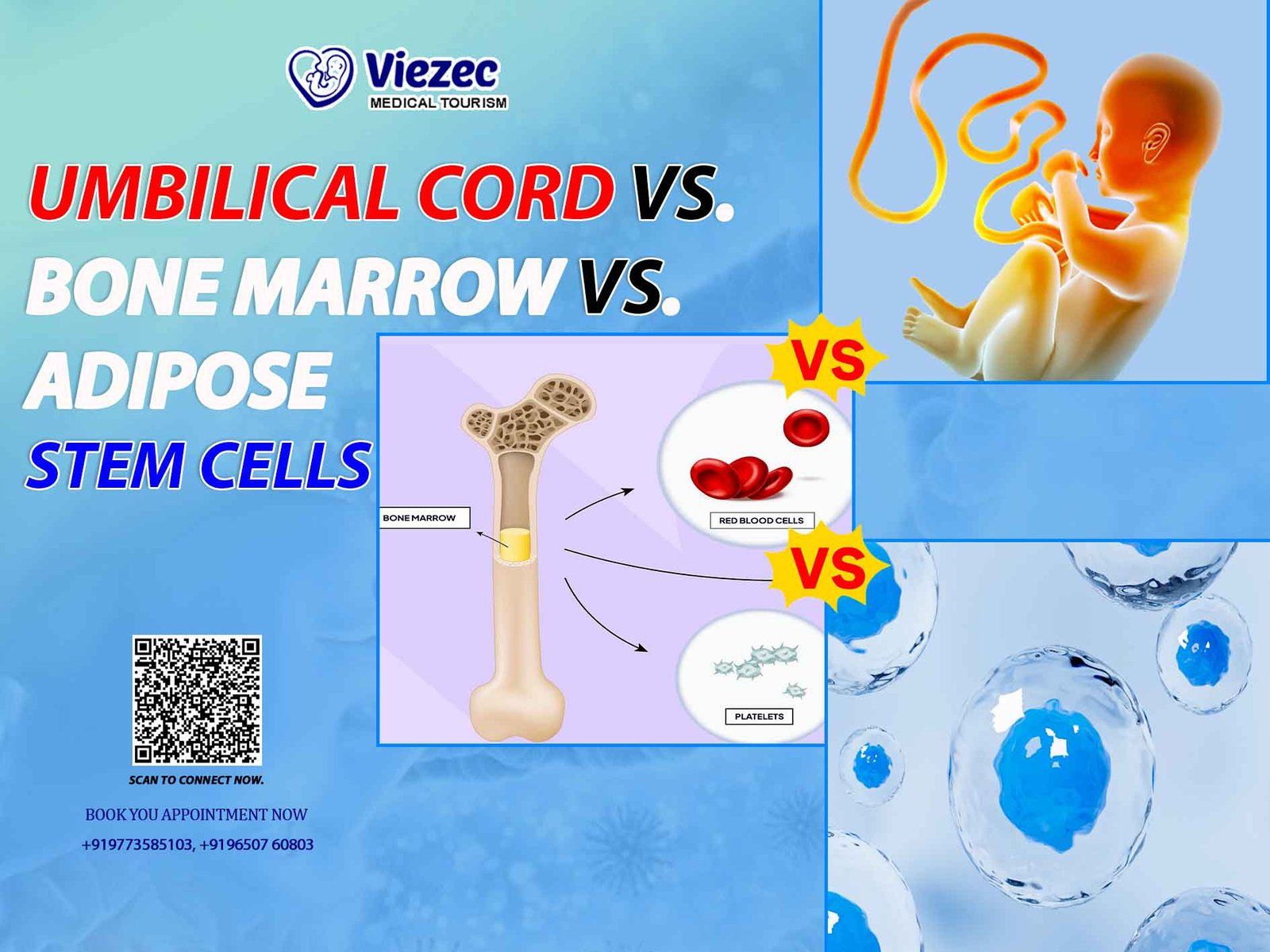
Umbilical Cord vs. Bone Marrow vs. Adipose Stem Cells
| Feature | Umbilical Cord MSCs | Bone Marrow MSCs | Adipose MSCs |
|---|---|---|---|
| Source | Donated after healthy birth | Taken from hip bone (aspiration) | Taken from abdominal fat (liposuction) |
| Potency | Highest | Moderate | Moderate–high |
| Cell Age | Youngest | Aged (depends on patient age) | Aged (depends on patient age) |
| Pain Level | No donor pain | Moderate (invasive) | Moderate |
| Cell Count | High | Low | High |
| Inflammation Control | Strong | Moderate | Strong |
| Use Cases | Arthritis, soft tissue injuries, immune modulation | Joint injuries, orthopedic conditions | Tendon repair, soft tissue healing |
| Safety | High (when screened) | Patient-specific | Patient-specific |
Why the Source Matters?
The effectiveness of a stem cell treatment depends on:
-
Cell viability
-
Potency and differentiation potential
-
Anti-inflammatory properties
-
Growth factor release
-
Patient age and health condition
-
Number of stem cells available for therapy
A 25-year-old patient will have more active bone marrow stem cells than a 65-year-old patient. Meanwhile, umbilical cord stem cells provide donor-derived cells that are biologically young and abundant.
Discover if Stem Cell Therapy Can Help You!
Book a Free Consultation with Our Experts at Viezec !
Umbilical Cord Stem Cells (Wharton’s Jelly)
Umbilical cord–derived mesenchymal stem cells (UC-MSCs) come from the Wharton’s Jelly of donated, healthy births. They are collected under ethical guidelines, screened, and processed in labs.
Why Umbilical Cord Stem Cells are Considered Highly Potent?
Umbilical cord MSCs are:
-
Biologically young, with long telomeres
-
Highly proliferative, meaning they multiply fast
-
Low in immune rejection (immune-privileged)
-
Rich in growth factors, cytokines, and exosomes
Benefits of UC-MSCs
-
No surgical procedure is needed
-
The donor is newborn, so cells are young
-
High number of viable stem cells
-
Excellent for inflammation reduction
-
Commonly used for arthritis, tendon injuries, and soft tissue repair
-
Effective in immunomodulation (helping regulate immune responses)
Clinical Uses of Umbilical Cord Stem Cells
-
Osteoarthritis of knee, hip, shoulder
-
Tendon injuries (Achilles tendonitis, rotator cuff)
-
Sports injuries
-
Chronic inflammation
-
Post-traumatic soft tissue damage
Bone Marrow Stem Cells
Bone marrow stem cells (BMSCs) are harvested from the iliac crest (hip bone). This requires a needle extraction procedure known as bone marrow aspiration.
Bone marrow stem cells have been used in orthopedic medicine for many years. They contain mesenchymal stem cells, hematopoietic cells, and growth factors that support tissue repair. However, the concentration and potency of bone marrow stem cells decline significantly with age. A 60–70-year-old patient typically has far fewer viable MSCs compared to someone in their 20s or 30s.
Advantages of Bone Marrow Stem Cells
-
Autologous (your own cells), reducing rejection risk
-
Traditionally used for musculoskeletal injuries
-
Good for cartilage repair
-
Can be combined with PRP (platelet-rich plasma)
Adipose-Derived Stem Cells (Fat Stem Cells)
Adipose tissue contains a large number of mesenchymal stem cells. These cells are collected through a mini-liposuction procedure. Adipose MSCs are known for their strong anti-inflammatory capacity and tissue-rebuilding potential.
Key Advantages of Adipose Stem Cells
-
Very high stem cell count
-
Effective for soft tissue, tendon, and ligament injuries
-
Good for chronic inflammation reduction
-
Less painful than bone marrow extraction
Adipose-derived stem cells have gained popularity because fat tissue holds more MSCs than bone marrow. Even in older adults, adipose stem cell levels remain relatively stable. For conditions like plantar fasciitis, tendonitis, and ligament sprains, adipose tissue offers a strong regenerative base. It also contains important healing molecules and structural cells that assist repair.
Which Stem Cell Type is Best for Musculoskeletal Conditions?
For arthritis (knee, hip, shoulder)
-
Umbilical cord stem cells offer the strongest anti-inflammatory effect.
-
Bone marrow helps rebuild cartilage but may be limited by low cell count in older adults.
-
Adipose stem cells help reduce inflammation and support joint cushioning.
For tendon, ligament, and soft tissue injuries
-
Adipose stem cells often perform well because fat tissue naturally supports soft tissue healing.
-
Umbilical cord MSCs also provide strong results due to high regenerative activity.
For patients over 50
Umbilical cord MSCs are typically preferred because the patient’s own cells are older and less potent.
For patients wanting autologous (their own) cells
Bone marrow or adipose-derived MSCs are suitable.
Start Your Regenerative Journey Today!
Contact Viezec for Personalized Stem Cell Therapy Plan
How Age Affects Stem Cell Potency?
Stem cell decline is a key factor in choosing the appropriate therapy.
As adults get older:
-
Bone marrow stem cells decrease by up to 95% by age 60
-
Adipose stem cells decrease moderately but still remain functional
-
Umbilical cord stem cells remain the “youngest” because they come from newborn tissue
Age-related decline affects:
-
Healing speed
-
Cell replication
-
Inflammation control
-
Tissue regeneration potential
This is why many clinics consider umbilical cord MSCs for older patients with arthritis or chronic pain.
Safety Considerations
Safety depends on the source, processing method, and clinic standards.
Umbilical Cord Stem Cells
-
When sourced from FDA- or nationally regulated tissue banks
-
Must undergo testing for contamination, viruses, and viability
-
No risk to donor or patient
Bone Marrow
-
Autologous cells, so low rejection risk
-
Procedure risks include bleeding, pain, or infection
Adipose Tissue
-
Liposuction-related risks: bruising, infection, anesthesia complications
Important:
Stem cell therapy outcomes vary. Not all patients respond the same way, and not all products marketed as “stem cell therapy” actually contain live stem cells. Choosing a reputable medical provider is essential.
How to Choose the Right Type of Stem Cell Therapy?
Choosing between umbilical cord, bone marrow, or adipose stem cells depends on:
-
Your condition
-
Your age
-
Your health status
-
Your treatment expectations
-
The clinic’s expertise
General Guidelines
-
Chronic arthritis → Umbilical cord or adipose MSCs
-
Cartilage injury → Bone marrow or umbilical cord
-
Tendon/ligament tear → Adipose or umbilical cord
-
Elderly patients → Umbilical cord
-
Patients who prefer their own cells → Bone marrow or adipose
Ask your provider these questions
-
What is the source of the stem cells?
-
How are the cells processed and stored?
-
What is the viability rate?
-
How many treatments are needed?
-
What outcomes should I realistically expect?
Is Your Condition Eligible for Stem Cell Therapy?
Speak directly with our specialist.
Emerging Research and Future Trends
Stem cell therapy continues to evolve. Researchers are working on:
-
Exosome therapy
-
Hybrid treatments (PRP + MSCs)
-
Gene-enhanced MSCs
-
Scaffold-based cartilage regeneration
The future of regenerative medicine likely involves combining multiple biologic therapies to enhance healing while reducing the need for surgery.
FAQs
The best source depends on the condition and patient age. Umbilical cord MSCs are the most potent, while bone marrow and adipose cells are useful for autologous treatments.
MSC therapy involves collecting or sourcing stem cells, processing them, and injecting them into the injured or inflamed area. The procedure supports healing, reduces pain, and improves tissue repair.
Mesenchymal stem cells can differentiate into bone, cartilage, muscle, tendon, fat, and connective tissue. Their regenerative ability helps repair damaged musculoskeletal structures.
MSCs exist in bone marrow, adipose tissue, umbilical cord tissue, and other connective tissues. Each source offers different levels of potency and cell count.
No, stem cell therapies vary by cell source, processing method, dosage, and clinical standards. Treatment quality and effectiveness depend heavily on the provider and the type of cells used.
Conclusion
Choosing between umbilical cord, bone marrow, and adipose stem cells depends on your individual condition, treatment goals, and overall health profile. Umbilical cord stem cells offer the strongest regenerative potential, especially for older adults or patients with chronic inflammation. Bone marrow and adipose tissue remain valuable autologous options, each with unique strengths.
Understanding these differences helps patients make informed decisions and improves the quality of care provided in regenerative medicine.
List of References -
Comparative Analysis of Mesenchymal Stem Cells From Umbilical Cord, Bone Marrow, and Adipose Tissue
https://www.sciencedirect.com/science/article/pii/S1934590916301461
The Aging of Mesenchymal Stem Cells: Influence on Their Regenerative Potential
https://stemcellsjournals.onlinelibrary.wiley.com/doi/full/10.1002/stem.2298
Adipose-Derived Stem Cells and Their Clinical Applications in Regenerative Medicine
https://www.thelancet.com/journals/lancet/article/PIIS0140-6736(19)30133-7/fulltext
Immunomodulatory Properties of Human Umbilical Cord Mesenchymal Stem Cells
https://stemcellres.biomedcentral.com/articles/10.1186/s13287-020-01763-8
Bone Marrow-Derived vs. Umbilical Cord-Derived MSCs for Musculoskeletal Regeneration: A Systematic Review
https://onlinelibrary.wiley.com/doi/10.1002/jor.24883